Noise in a townhouse mostly travels through the party wall you share with your neighbour, and through “flanking” paths around it: floors, stairs, ductwork and plumbing that run alongside the wall. Ontario’s Building Code sets a minimum sound rating for walls between homes, but older townhouses were built to lower standards and workmanship varies. The best protection is to test for noise before you buy, choose an end unit or a layout that keeps stairs and bedrooms away from the shared wall, and know your rights if a problem comes up later.
Key takeaways
- The Building Code sets a minimum STC 50 rating for walls between dwelling units; recent editions also require the whole assembly to reach ASTC 47.
- Most townhouse noise complaints involve footsteps, stairs, voices and TVs on the other side of a shared wall.
- Visit at night and on a weekend, and ask the sellers directly about neighbour noise.
- An end unit halves your shared walls; a back-to-back adds a third.
- In a condo townhouse, the declaration and rules usually contain noise provisions the corporation can enforce.
How much noise should you expect in a townhouse?
Some. A townhouse is a house with neighbours on the other side of the wall, and no wall stops every sound. In a well-built modern townhouse, normal conversation next door should be faint or inaudible, while loud music, a slammed door or a toddler running down the stairs may still come through.
Ontario’s Building Code sets the floor. Walls separating dwelling units must achieve a sound transmission class (STC) of at least 50. Newer editions of the code added a second test, apparent STC (ASTC) 47, which measures the performance of the whole assembly, including the floors, ceilings and outside walls connected to it. That matters because sound often bypasses a good wall by travelling through the structure around it.
Homes built before those requirements were designed under older rules, and some older townhouses have far less separation than a new one. Age alone is not a verdict, though. A solid masonry party wall in an older Toronto row house can perform very well.
Where townhouse noise actually comes from
- Stairs against the party wall: many designs put the staircase on the shared wall. Footsteps on stairs are impact noise, which travels through framing more easily than airborne sound.
- Back-to-back layouts: a shared rear wall adds a third neighbour, often with their kitchen or bathroom right behind yours.
- Stacked units: the noise is vertical, with footsteps overhead the main complaint for lower units.
- Plumbing and ducts: drains in a shared wall, or ducts that pass close to it, can carry sound.
- Electrical outlets back to back: outlets placed in the same stud bay on both sides create a small gap in the wall.
- Attics in older townhouses: if the party wall does not run continuously to the roof deck, sound and smoke can pass over it.
How to check for noise before you buy a townhouse
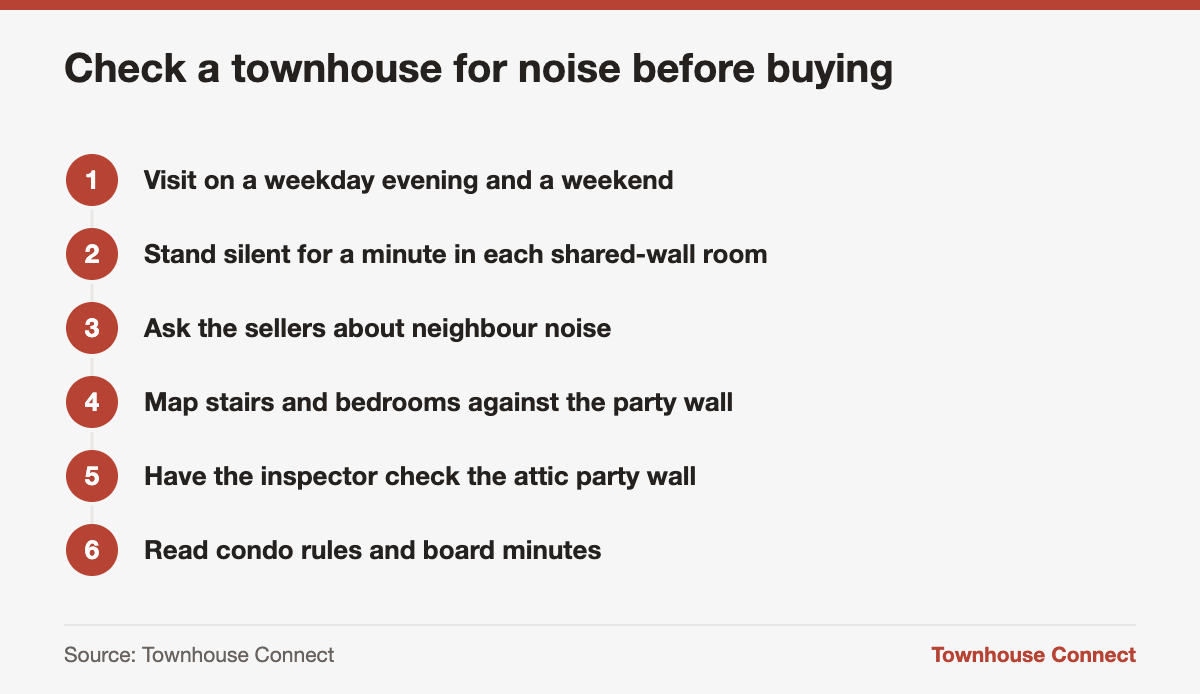
- Visit at the right times. A Tuesday at 11 a.m. tells you nothing. Go on a weekday evening and on a weekend afternoon.
- Stand still and listen. In each room against a shared wall, stop talking for a full minute.
- Ask the sellers directly. Ask whether they have heard neighbours, and when. Their answer, and their hesitation, are both informative.
- Look at the layout. Note where your bedrooms and the neighbour’s stairs are likely to be. In a complex, the unit next door is usually the same plan, flipped.
- Ask the inspector to check the attic. In older townhouses, the party wall should be continuous from the foundation to the underside of the roof.
- For condos, read the rules and minutes. Repeated noise complaints often show up in board minutes.
Tip: Ask the sellers, in general terms, about the neighbours’ routines. Shift work, young children or a home music studio next door can change your experience more than the wall itself. A friendly chat with a neighbour you meet outside during a second showing is also perfectly normal in townhouse communities.
Party walls: who owns them and who fixes them?
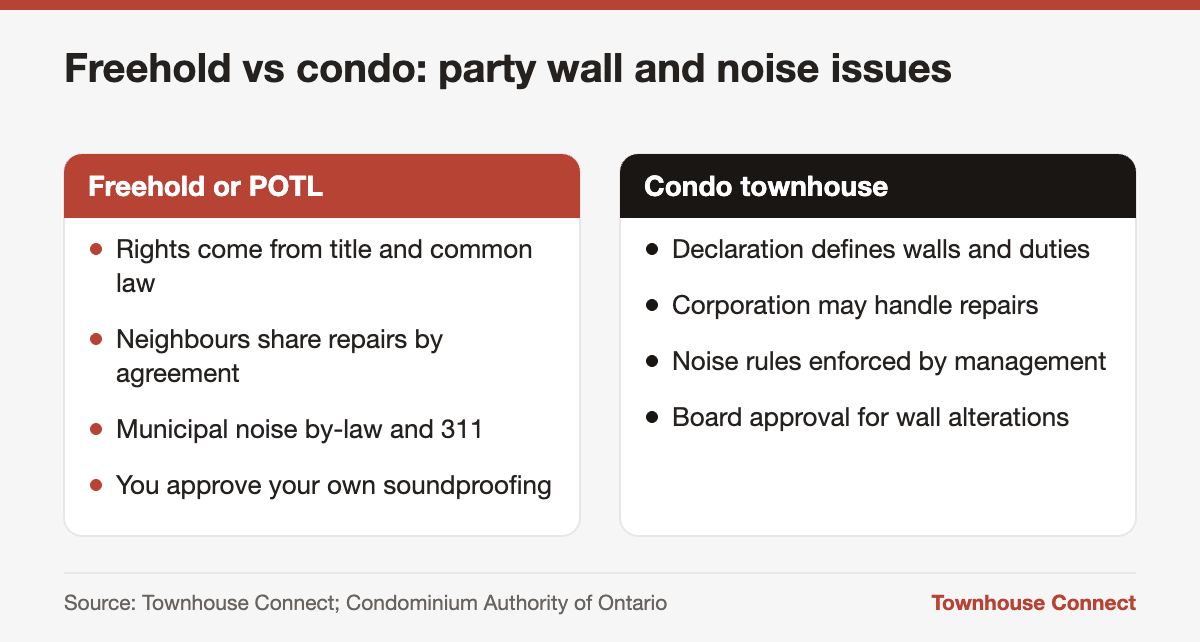
In a freehold or POTL townhouse, each owner usually owns their side of the shared wall, with rights of support and maintenance shared with the neighbour. Those rights generally come from what is registered on title, such as party wall agreements or easements, and from common law. Ontario does not have a general party wall statute that sets one procedure, so your lawyer should check what is registered on the property you are buying.
In practice, repairs to a shared wall, a shared roof or a shared chimney work best when neighbours agree on scope, contractor and cost split in writing before work starts. If one owner refuses to cooperate, the options are negotiation, mediation or, as a last resort, legal advice.
In a condo townhouse, the declaration decides. The walls between units are often defined as common elements or as part of the units, and the corporation’s repair duty follows from that definition. Our post on stacked, back-to-back and row townhouses covers how the form affects these questions.
Soundproofing a townhouse party wall
If you already own and noise is a problem, there are improvements that help. Results depend on where the sound is actually getting through, so start with the cheapest steps.
Low-cost fixes
- Seal gaps at baseboards, outlets and where pipes pass through the shared wall with acoustic sealant.
- Add heavy furniture, such as full bookcases, against the shared wall.
- Put rugs and underlay on stairs and floors near the party wall, and ask a neighbour to do the same.
Bigger projects
- Add a second layer of drywall with a damping compound, or build a separate stud wall with insulation in front of the existing one.
- Use resilient channels or isolation clips to decouple new drywall from the framing.
- For a condo townhouse, get the corporation’s approval before altering any wall it is responsible for.
A building permit may be needed for some work, and an acoustical consultant can identify the weak point before you spend money on the wrong fix.
Your options when a neighbour is too loud
Start with a polite conversation. Most townhouse neighbours have no idea how much travels through the wall, and they often hear you too.
If that fails, municipal noise by-laws apply. Toronto’s noise rules sit in Chapter 591 of the Municipal Code, which a 2022 amendment updated for items such as power devices, which that amendment restricts from 7 p.m. to 8 a.m., or until 9 a.m. on weekends and statutory holidays. Persistent noise complaints go through 311.
In a condo townhouse, check the declaration and rules first, since most contain provisions on noise and nuisance. Report the issue in writing to management. If it stays unresolved, the Condominium Authority of Ontario runs the Condominium Authority Tribunal, which resolves certain disputes under condo governing documents; check whether your issue falls within its jurisdiction.
Before buying in a complex, our status certificate review helps you spot noise disputes and legal actions, and our five costly buyer mistakes covers skipping this kind of homework.
Frequently asked questions
Are townhouses noisy?
They can be, but many are not. Newer townhouses must meet Building Code sound standards for walls between units, and well-built ones are often quiet. Noise depends on construction quality, layout and the neighbours’ habits. End units, layouts with closets or stairs away from the shared wall, and homes with solid masonry party walls tend to perform best.
What is a good STC rating for a townhouse wall?
Ontario’s Building Code requires at least STC 50 for walls between dwelling units, and recent editions also require the overall assembly to reach ASTC 47. Higher ratings mean better separation. Most buyers cannot measure this themselves, so rely on visits at busy times, the sellers’ answers and, if needed, an acoustical consultant.
Is an end unit townhouse quieter?
Usually, because it shares only one wall instead of two, which removes one set of neighbours entirely. The trade-off is an exterior side wall that may face a street, walkway or parking area, which brings its own noise. Visit at different times and stand on the open side of the house as well.
Looking for a quieter townhouse? Browse townhouses across the GTA and ask us to shortlist end units and layouts that keep bedrooms away from the party wall.
This article is general information as of October 2026, not legal, tax, mortgage or financial advice. Rules and numbers change, so confirm the details for your situation with a licensed professional.