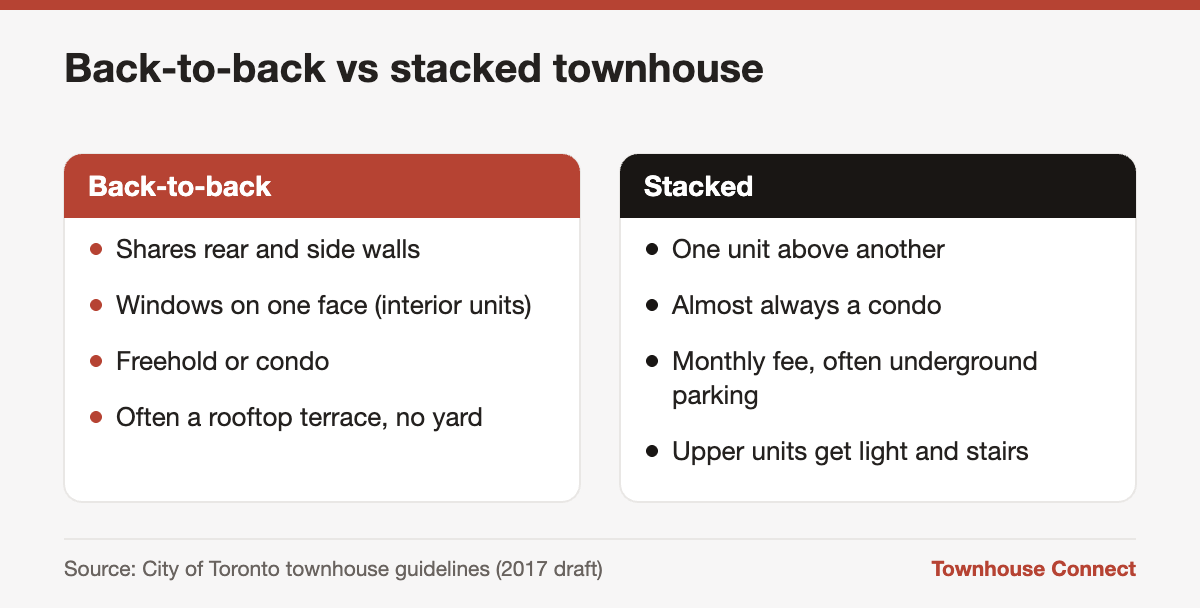
A row townhouse shares side walls with its neighbours and has a front and a back. A back-to-back townhouse also shares its rear wall, so it has only one exposed face and usually no backyard. A stacked townhouse puts one unit on top of another, typically two or three high, and is almost always owned as a condominium. Row towns cost the most and give you the most house; stacked towns are the cheapest way into townhouse living, with trade-offs in light, stairs and fees.
Key takeaways
- Row (street) townhouses can be freehold, POTL or condo; stacked townhouses are almost always condos.
- Back-to-back units have windows on one side only, unless you buy an end unit.
- Toronto’s zoning treats stacked back-to-back buildings as apartment buildings, with parking usually underground.
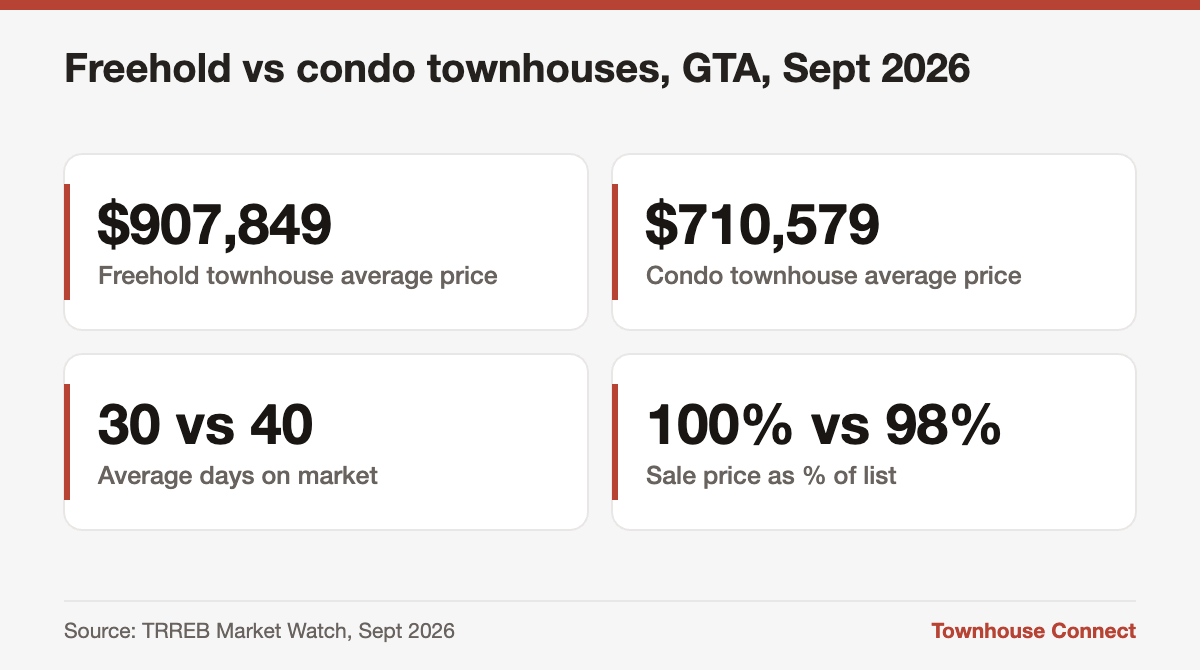
- Condo townhouses, the TRREB category where many stacked units are listed, averaged $710,579 in September versus $907,849 for freehold towns.
- Before choosing, check light, stairs, outdoor space, parking and the monthly fee.
What are the main types of townhouses?
The City of Toronto’s draft townhouse and low-rise apartment guidelines describe four built forms. The definitions are useful anywhere in Ontario, because builders across the GTA use the same designs.
| Type | How it is built | Typical ownership |
|---|---|---|
| Row (street) townhouse | 2 to 4 storeys, shares side walls, has a front and a back | Freehold, POTL or condo |
| Back-to-back townhouse | Shares a rear wall and side walls; the block has two fronts | Freehold or condo |
| Stacked townhouse | Units stacked vertically, typically two or three high, with a front and a back | Condo |
| Stacked back-to-back | Stacked units that also share a rear wall; each unit usually has its own entrance at grade | Condo |
The draft guidelines note that the stacked back-to-back type is classed as an “Apartment Building” under Toronto’s city-wide zoning by-law, and that parking for stacked and back-to-back forms is provided underground. That classification explains a lot about how these buildings feel and cost to own.
Row townhouses: the closest thing to a house
A traditional row townhouse gives you a front door on the street, a backyard or deck, and windows at both ends of the home. Light comes from two directions and you can get a cross-breeze through the main floor.
Many row townhouses in the 905 are freehold, with no monthly fee and an integral garage. Others sit on a private road as POTL or condo townhouses. If you are weighing those tenures, our post on POTL townhouses explains how fees and maintenance differ.
The trade-off is price. TRREB’s September 2026 Market Watch put the average freehold (att/row) townhouse at $907,849 across the GTA, compared with $710,579 for condo townhouses.
Back-to-back townhouses: pros and cons
A back-to-back block puts two rows of homes against each other, so each unit faces one street or walkway and shares three walls. Builders like the form because it fits more homes on a site.
Advantages
- Usually priced below a comparable row townhouse in the same community; check recent sales to confirm.
- Often three storeys plus a rooftop terrace, which can make up for the missing yard.
- Fewer exterior walls, which can mean lower heating costs.
Drawbacks
- Windows on one face only for interior units, so rooms at the back of the plan can be dark.
- No cross-ventilation, which matters in July.
- Little or no private ground-level outdoor space.
- More shared walls means more potential neighbour noise.
End units change the equation. A back-to-back end unit gains windows on a side wall, and in a back-to-back block that can be the difference between a bright home and a tunnel. Expect to pay more for it.
Tip: Visit a back-to-back townhouse twice, once around noon and once late in the afternoon. With windows on one side only, orientation matters more than in any other townhouse type. A unit facing south or west usually gets far more direct light than an identical one facing north.
Stacked townhouses: what you are really buying
A stacked townhouse is closer to a low-rise condo with private entrances. The lower unit often has the main floor and a lower level, sometimes partly below grade. The upper unit usually starts one or two floors up and may include a private rooftop terrace.
Upper vs lower stacked units
- Upper units: more light, more privacy, no one walking overhead, and often a terrace. You will climb a lot of stairs, which matters with groceries, strollers and ageing knees.
- Lower units: fewer stairs and sometimes a small patio, but footsteps from the unit above and less natural light in the lower level.
Because the units are stacked, you cannot own the land beneath you, so stacked towns are condominiums. That brings a monthly fee, a status certificate, a reserve fund and a set of rules on renting, pets and renovations. Parking is usually in an underground garage shared with the rest of the complex, which is part of what the fee pays for.
Which type holds value best?
There is no public benchmark split by townhouse design, so be wary of anyone quoting precise numbers. What the data does show is the gap between freehold and condo townhouses, and stacked units, as condos, sit on the condo side of it.
- Freehold townhouses sold in an average of 30 days at 100% of list price in September 2026.
- Condo townhouses took 40 days and sold at 98% of list.
- There were 2,097 active condo townhouse listings against 355 sales, versus 1,854 freehold listings against 448 sales.
In plain terms, condo townhouses, which include many stacked units, face more competition from other listings right now. Buyers have more room to negotiate on them, and sellers should expect a longer sale. Our townhouse vs semi-detached price comparison has more on how the categories are moving.
How to choose between stacked, back-to-back and row
- Count the stairs you will actually climb. A three-storey back-to-back or an upper stacked unit can mean several flights between the front door and the bedroom.
- Check where the light comes from. One-sided units need good orientation.
- Decide how much outdoor space you need. A dog or a toddler changes the answer.
- Look at parking. Underground spaces, tandem garages and visitor rules vary widely.
- Price the fee into your budget. Lenders count half of condo fees when qualifying you, so a $450 fee reduces what you can borrow.
- Ask about resale. Check how long similar units in the same complex took to sell.
If you are still sorting out what suits you, our townhouse swipe tool lets you compare listings by type and layout quickly.
Frequently asked questions
Are stacked townhouses condos?
Almost always, yes. Because one unit sits on top of another, the owners cannot each own the land underneath, so stacked townhouses in Ontario are built as condominium units. You own your unit and a share of the common elements, pay monthly fees, and are bound by the corporation’s declaration, by-laws and rules.
What is the downside of a back-to-back townhouse?
The biggest downside is light. Interior back-to-back units share their rear wall, so all windows are on one side, and rooms at the back of the floor plan can be dim. You also lose cross-ventilation and usually a backyard. End units ease these issues because they add windows on a side wall.
Can a back-to-back townhouse be freehold?
Yes. Back-to-back townhouses can be built as freehold homes, POTLs on a common elements road, or condo units, depending on how the builder registered the development. Check the listing and the title. A freehold back-to-back has no monthly fee, but you are responsible for your own roof and exterior, coordinated with the neighbours you share walls with.
Is a stacked townhouse a good first home?
It can be. Stacked units are among the most affordable ways to get townhouse-style living with a private entrance, and many are newer. The trade-offs are monthly fees, stairs, shared walls and floors, and a resale market that is currently slower than for freehold townhouses. Read the status certificate carefully before you firm up.
Ready to compare? See North York townhouses for sale, check Mississauga listings, or browse all GTA townhouse listings by type.
This article is general information as of October 2026, not legal, tax, mortgage or financial advice. Rules and numbers change, so confirm the details for your situation with a licensed professional.