A POTL townhouse is a freehold home and lot, called a parcel of tied land, that is permanently tied to a common elements condominium corporation. You own your house and land outright, while the corporation owns and maintains shared items like a private road, visitor parking or landscaping, and you pay a monthly fee for your share. Because the two can never be separated, the fee and the corporation’s rules come with the house when you buy or sell.
Key takeaways
- With a POTL you own the house, roof and lot; the corporation owns only the shared common elements.
- Your interest in the common elements cannot be severed from your lot, on sale or otherwise.
- Unpaid POTL fees can become a lien on your property, as with any condo.
- A POTL corporation must keep a reserve fund, so check its health before you buy.
- New POTL townhouses count as freehold for Tarion, so the 45-day registration rule applies.
What is a parcel of tied land (POTL)?
Ontario’s Condominium Act, 1998 allows a type of condo called a common elements condominium corporation. Unlike a standard condo, it has no units. It owns only shared land and facilities, and each share is attached to a separate freehold property. Those freehold properties are the parcels of tied land.
In a typical townhouse community, the corporation might own the private roadway, visitor parking spaces, a parkette, entrance features, or shared water and sewer services. The townhouses themselves sit on freehold lots registered in the owners’ names.
The tie is legal and permanent. A common elements declaration filed with the Town of Caledon, which is a good example of the form, states plainly that “the common interest cannot be severed from the Parcel.” When you sell your townhouse, the buyer gets your share of the corporation automatically.
The province also requires that each parcel be capable of being conveyed on its own under the Planning Act. Since 2008, a solicitor has had to confirm that in the declaration before registration, according to an Ontario land registration bulletin on POTLs.
POTL vs condo townhouse vs freehold: what’s the difference?
Our freehold vs condo townhouse page covers the basic split. POTLs sit in between.
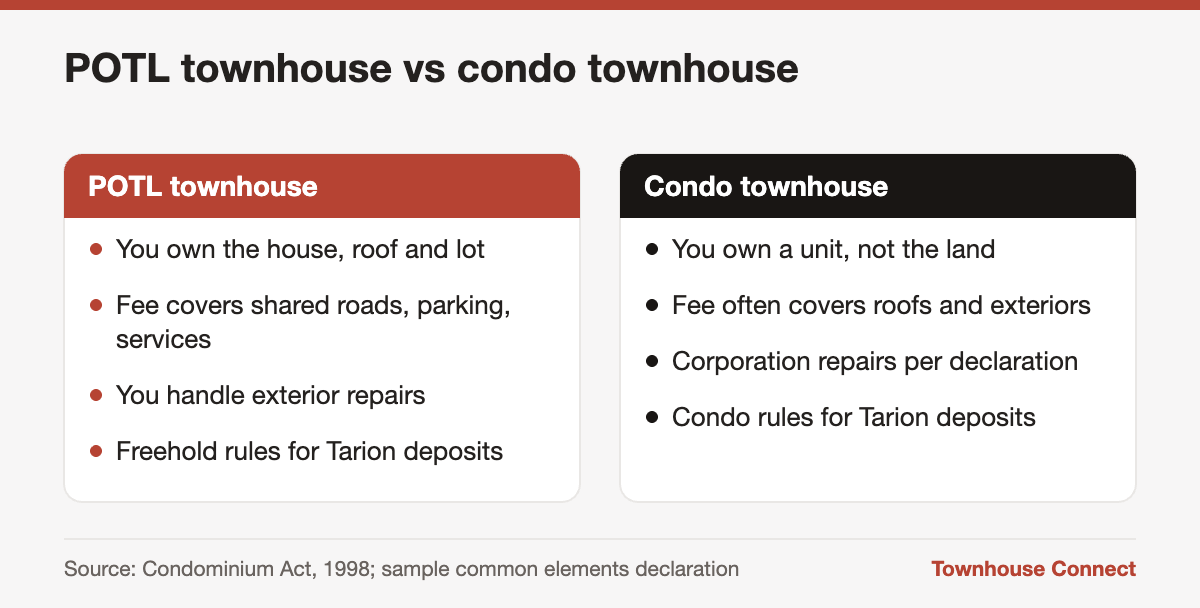
| Feature | Freehold townhouse | POTL townhouse | Condo townhouse |
|---|---|---|---|
| You own the land | Yes | Yes | No (you own a unit) |
| Monthly fee | None | Yes, for shared elements | Yes, often for exteriors too |
| Roof and exterior repairs | You | Usually you | Usually the corporation, per declaration |
| Road and snow removal | Municipality | Corporation, for private roads | Corporation |
| Status certificate | Not applicable | Yes | Yes |
| Tarion deposit rules (new) | Freehold | Freehold | Condo |
What do POTL fees cover?
A POTL fee is your share of the common elements corporation’s budget. Each owner pays a proportionate share set out in the declaration. In the Caledon example, the listed expense categories include insurance, utilities, snow removal, road and sewer maintenance, and contributions to the reserve fund.
Because the corporation is not maintaining your roof, windows or siding, POTL fees are usually well below the fees in a standard condo townhouse complex where the corporation handles exteriors. That said, the amount varies a great deal with what the corporation owns. A community with a long private road, underground services and landscaped parkettes costs more to run than a single lane with a few visitor spaces.
What happens if you don’t pay?
The corporation can register a lien against your parcel, in the same way a standard condo can against a unit. In the Caledon declaration, the corporation is directed to maintain and enforce that lien against defaulting owners. Unpaid fees can therefore affect your title, not just your credit.
What you maintain, and what the corporation maintains
The declaration is the rulebook, and it differs by community. The Caledon example splits duties like this:
- Owners: the landscaping installed by the builder within their lot, privacy fencing on or along their lot, and any damage caused by their own negligence.
- Corporation: the common elements, shared services such as water mains and sewers, perimeter fencing, and catch basins and storm features within each lot.
- Approvals: owners cannot change builder-installed landscaping or fencing without written consent.
That declaration also lets the corporation do repairs an owner neglects and recover the cost with interest at 18% a year. Clauses like that are why reading the declaration matters before you firm up an offer.
Tip: Check the rules on parking before you buy a POTL townhouse. Many communities ban parking on the private road entirely, and the Caledon declaration does exactly that. If your household has three cars and the townhouse has a single garage and a one-car driveway, visitor parking rules will shape your daily life.
The POTL status certificate and reserve fund
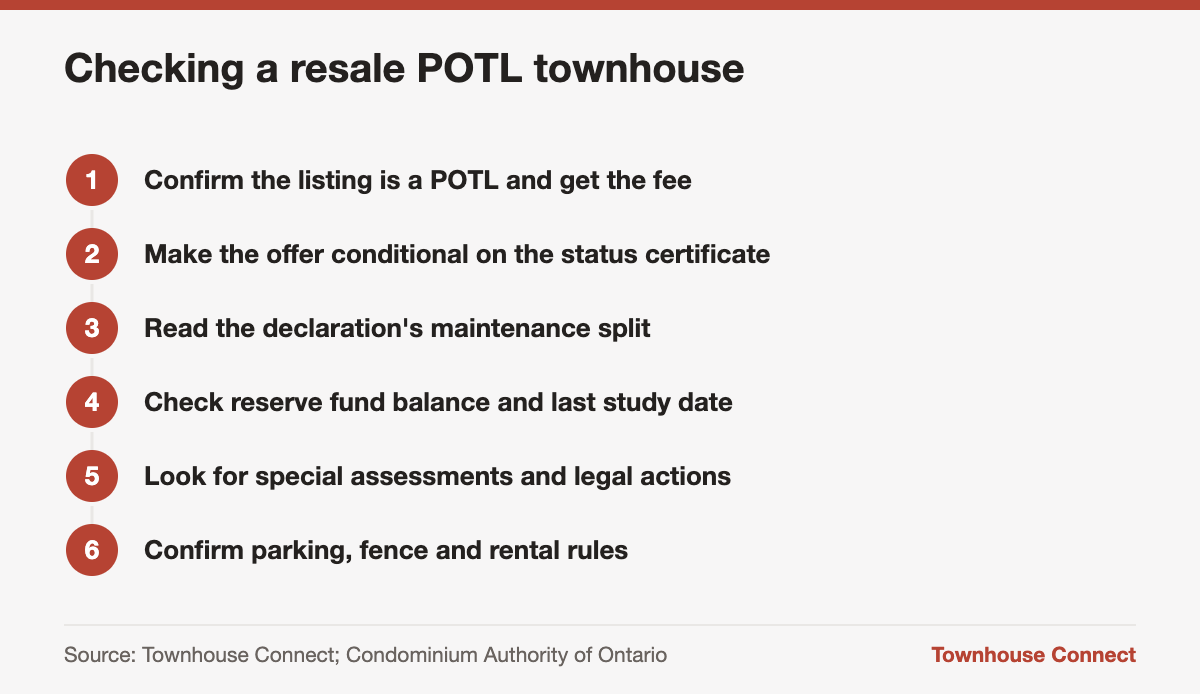
Because a common elements corporation is a condominium corporation, you can request a status certificate when buying a resale POTL townhouse. The Condominium Authority of Ontario says the fee is capped at $100 including taxes, and the corporation must deliver it within 10 days.
Read it with the same care you would for a condo, with a focus on:
- The monthly fee and any planned increases.
- The reserve fund balance and the date of the last reserve fund study.
- Any special assessments, for example to cover road repaving.
- Legal actions involving the corporation.
- Rules on parking, fences, sheds, satellite dishes and rentals.
Our status certificate review page explains what each section means. Like every condo corporation, a POTL corporation must keep a reserve fund for major repairs and replacement of the common elements, and the Caledon declaration bars that fund from being used for anything else.
Buying a new POTL townhouse
For a new POTL townhouse, the freehold rules apply to your deposit. Since April 1, 2026, you should notify Tarion within 45 days of signing to get full deposit protection, as explained in our post on Tarion’s 45-day rule. If the home is your primary residence and you sign by March 31, 2027, it may also qualify for Ontario’s enhanced HST rebate.
New common elements corporations often start with modest fees, because the builder’s budget only has to cover early costs. The Caledon example gives owners no fees during the first year after registration and until the builder transfers title. Expect the fee to change once the first reserve fund study is done.
Pros and cons of buying a POTL townhouse
Advantages
- You own your land and control your own roof, windows and interior.
- Fees are usually lower than in a standard condo townhouse complex.
- A private road can mean less traffic and a quieter street.
Drawbacks
- You pay for your own exterior repairs and a monthly fee.
- The corporation’s rules limit some choices, such as parking and landscaping.
- Shared assets like roads eventually need costly replacement, which the reserve fund must cover.
Frequently asked questions
Is a POTL townhouse freehold or condo?
Both, in a sense. The house and lot are freehold and registered in your name. Your lot is tied to a common elements condominium corporation that owns shared items like a private road, and you pay a monthly fee to it. For Tarion deposit protection on a new home, a POTL is treated as freehold.
Can you sell a POTL without the common elements share?
No. The common interest is permanently attached to the parcel and cannot be severed, either on a sale or when a lender enforces a mortgage. Anyone who buys your townhouse automatically becomes a member of the corporation and takes on the fee and the rules set out in the declaration and by-laws.
Are POTL fees the same as condo fees?
They work the same way legally, as a share of the corporation’s common expenses, and unpaid amounts can become a lien. The difference is scope. A POTL corporation maintains only shared elements such as roads and visitor parking, so its budget is usually smaller than a condo townhouse corporation that also maintains roofs, windows and exteriors.
Do I need a status certificate for a POTL townhouse?
It is strongly recommended. The status certificate shows the fee, the reserve fund, special assessments, legal actions and the governing documents. Under Ontario rules the fee is capped at $100 including taxes and it must be delivered within 10 days, so make your offer conditional on a satisfactory review by your lawyer.
Looking at POTL communities? Browse townhouses for sale across the GTA, or ask us to pull the declaration and fee history before you make an offer.
This article is general information as of October 2026, not legal, tax, mortgage or financial advice. Rules and numbers change, so confirm the details for your situation with a licensed professional.