
Before you buy a condo townhouse, check three things about its reserve fund: the date and class of the last reserve fund study, whether the funding plan calls for sharp increases, and whether any special assessment is planned or under way. You will find all three in the status certificate and its attachments. Townhouse complexes often own roofs, windows, roads and fences, so a weak reserve fund can turn into a five-figure bill for each owner.
Key takeaways
- Ontario condos must do a comprehensive reserve fund study within a year of registration, then an updated study at least every three years.
- The status certificate must disclose the reserve balance, contributions, the last study date and any special assessments.
- Look at the 30-year funding plan, not just today’s balance; big future jumps mean higher fees are coming.
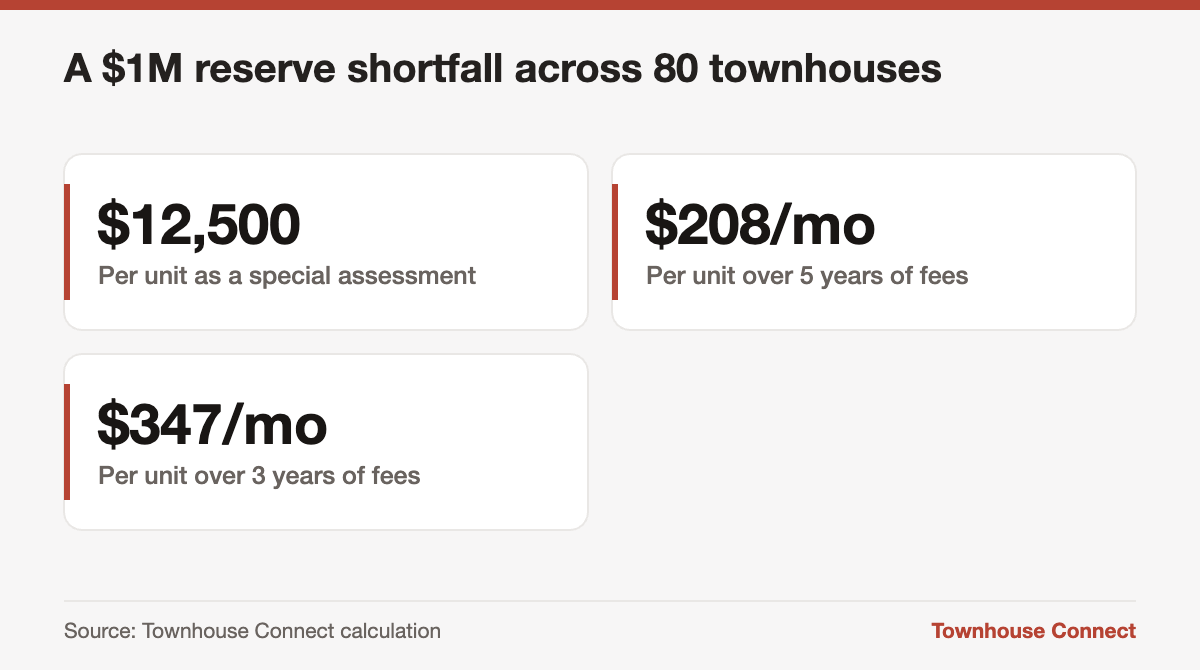
- A $1 million shortfall split among 80 units is $12,500 each if shares are equal.
- Check the declaration to see which components the corporation, rather than the owner, has to replace.
What is a condo reserve fund, and why it matters more in townhouses
A reserve fund is a mandatory account a condominium corporation uses to pay for major repairs and replacement of common elements and assets. The Condominium Authority of Ontario stresses that it is for major work, not routine maintenance.
In an apartment condo, the big items are elevators, mechanical systems and the building envelope. In a condo townhouse complex, the list often includes every roof in the community, the windows and doors, siding or brick, private roads and driveways, fences, decks and the underground garage if there is one. Those components wear out on similar schedules, so a complex built in one phase can face several large projects within a few years of each other.
Exactly what the corporation must replace depends on the declaration. Some condo townhouse declarations make owners responsible for certain items, such as windows or decks. Read it alongside the reserve fund study so you know what the fund is meant to cover.
How reserve fund studies work in Ontario
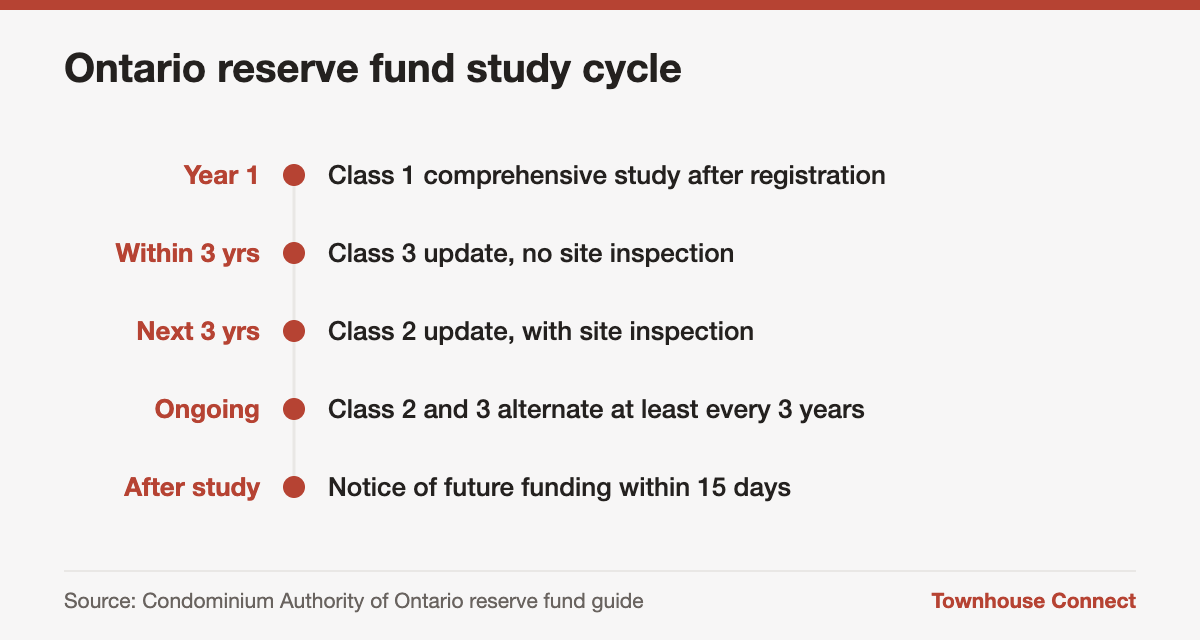
According to the CAO’s guide to condo reserve funds, studies follow a set cycle.
| Study | What it involves | When |
|---|---|---|
| Class 1 (comprehensive) | In-person inspection, records review, interviews, 30-year projection | Within one year of registration |
| Class 3 (update) | Records review and interviews, no site inspection | Within the following three years |
| Class 2 (update) | Updated study with a site inspection | Alternates with Class 3, at least every three years |
After each study, the board proposes a plan for future funding. It must send owners a notice of future funding within 15 days of proposing the plan, and the plan takes effect on the 31st day after the notice and documents go to the auditor. Before the first study, a new corporation must contribute at least 10% of its operating budget or the amount reasonably expected to be needed, whichever is greater.
What to look for in the status certificate
The status certificate is the corporation’s official statement about the unit and its finances, and the CAO guide notes that it legally binds the corporation to the information it provides. Our status certificate review page explains every section. For the reserve fund, focus on:
- The current reserve fund balance and the annual contribution.
- The date of the last reserve fund study and when the next is due. A study more than three years old is a red flag.
- The most recent notice of future funding, which shows planned contribution increases.
- Any special assessments already levied or planned.
- Planned increases to common expenses for the coming year.
- Legal actions, which can drain both operating and reserve funds.
Tip: Ask for the full reserve fund study, not just the summary in the status certificate. Turn to the 30-year cash flow table and look for the year the balance gets lowest. If the roofs, windows and road paving all fall due in a short span and the balance dips close to zero, expect higher fees or a special assessment, even if today’s balance looks healthy.
Special assessments in condo townhouses: what can happen
A special assessment is a one-time charge to owners, sometimes split into instalments. The CAO guide describes it as an alternative when money is needed quickly, and notes that owners commonly resist it. The guide’s preferred approach is to raise fees gradually. Borrowing is another option, but a loan requires a borrowing by-law approved by owners.
An illustration
Suppose a complex of 80 townhouses needs a $1.6 million roof replacement program, and $600,000 is available in the reserve fund for it. The shortfall is $1 million. These are illustrative numbers, not a typical cost.
- As a special assessment split equally, each owner pays $12,500.
- Spread through fee increases over five years, it works out to about $208 a month per unit.
- Over three years, it is about $347 a month per unit.
In reality, each owner’s share follows the proportions set in the declaration, which often vary with unit size. Either way, a buyer who misses this in the status certificate inherits it.
Red flags and green flags in a townhouse reserve fund
Red flags
- No updated study in more than three years.
- A funding plan with large contribution jumps in the next few years.
- A recent special assessment, or minutes discussing one.
- Major components such as roofs or windows listed as near the end of their life, with little money set aside.
- Fees that have not changed in many years in an older complex.
Green flags
- A recent study with a site inspection.
- Steady, predictable contribution increases that follow the plan.
- Recent completion of a big project, such as new roofs, paid from reserves.
- Clear board minutes that discuss upcoming work and how it will be funded.
Does a low fee mean a good deal?
Not always. A condo townhouse with unusually low fees may simply be under-saving, and the bill arrives later. When you compare two complexes, compare what the fee covers and how well funded each reserve is. A slightly higher fee in a complex with a healthy reserve and new roofs can be the cheaper choice over ten years.
The same logic applies to POTLs, whose corporations must also keep a reserve fund for shared items like private roads. Our POTL townhouse explainer covers how those fees differ. And because condo townhouses are selling at about 98% of list this fall, a reserve fund issue is a legitimate reason to negotiate the price, as our post on selling in a buyer’s market shows from the other side.
Frequently asked questions
How often do condo reserve fund studies have to be done in Ontario?
A comprehensive Class 1 study is required within the first year after the condominium is registered. After that, updated studies are required at least every three years, alternating between a Class 3 update without a site inspection and a Class 2 update with one, according to the Condominium Authority of Ontario’s reserve fund guide.
Can a condo corporation charge a special assessment without a vote?
The CAO’s reserve fund guide does not describe an owner vote for special assessments, but it does say that borrowing requires a by-law approved by owners. Special assessments are generally a board decision based on the corporation’s needs. Read the status certificate and recent minutes before buying so you know whether one is planned.
Who pays a special assessment when a townhouse is sold?
That depends on the timing and the purchase agreement. The status certificate discloses assessments already levied against the unit, and buyers often negotiate who pays outstanding amounts. If an assessment is approved after the certificate date, the outcome depends on the agreement’s wording, so your lawyer should address it before you firm up.
Comparing condo townhouses? Search townhouse listings across the GTA, and read our five costly buyer mistakes before you waive a status certificate condition.
This article is general information as of October 2026, not legal, tax, mortgage or financial advice. Rules and numbers change, so confirm the details for your situation with a licensed professional.