Who fixes the roof, driveway and snow in a townhouse depends on how it is owned. In a freehold townhouse you are responsible for everything on your lot, including your section of a shared roof. In a POTL, the common elements corporation looks after shared items like the private road, while you handle your house. In a condo townhouse, the corporation repairs the common elements by default, but the declaration can shift specific items, such as windows, decks or driveways, to owners.
Key takeaways
- Freehold owners pay for their own roof, windows, driveway and snow clearing, and coordinate shared items with neighbours.
- POTL owners usually maintain their own house and lot; the corporation handles the road, visitor parking and shared services.
- Under the Condominium Act, condo corporations repair common elements, but section 91 lets the declaration change that split.
- Shared roofs and shared driveways are frequent sources of friction between townhouse neighbours.
- Before buying, get the declaration or check title for easements so you know your obligations.
Who is responsible for repairs in a townhouse?
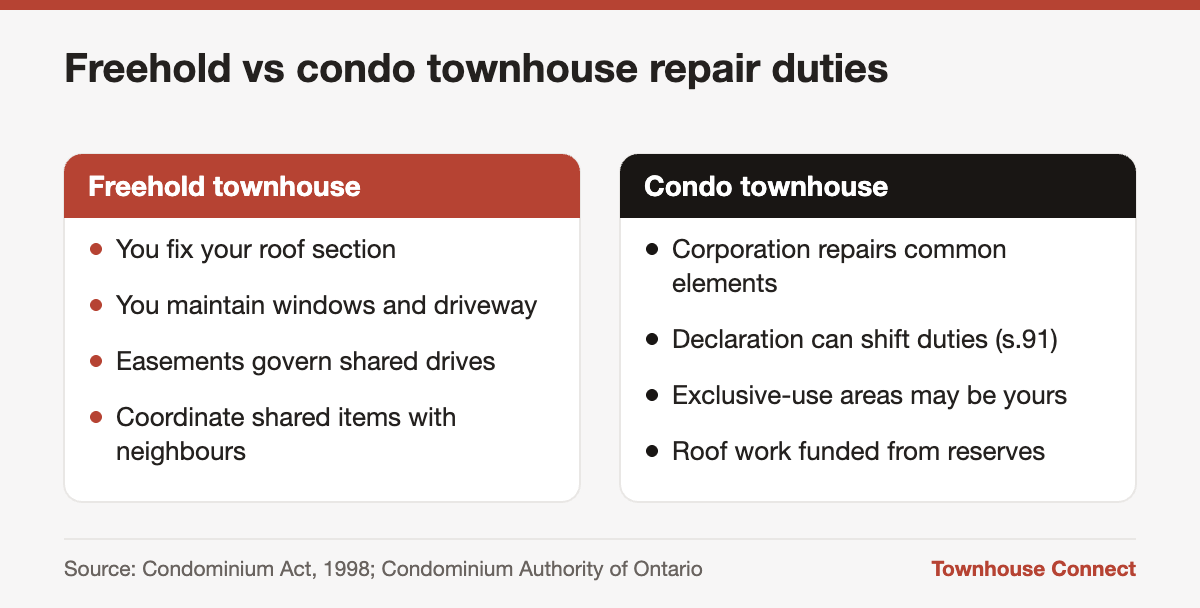
The short answer is: whoever owns it, unless a document says otherwise. The table shows the usual pattern. Always check the actual title documents or declaration, because exceptions are common.
| Item | Freehold | POTL | Condo townhouse |
|---|---|---|---|
| Roof over your home | You | Usually you | Usually the corporation |
| Windows and doors | You | You | Varies by declaration |
| Driveway on your lot | You | Usually you | Often the corporation; may be exclusive-use |
| Private road | n/a (public street) | Corporation | Corporation |
| Snow on the road | Municipality | Corporation | Corporation |
| Snow on your walkway and driveway | You | Usually you | Varies by rules |
| Fences | You and neighbours | Per declaration | Usually the corporation |
| Interior and upgrades | You | You | You |
Freehold townhouses: your lot, your problem
With a freehold townhouse, you own the land and building outright. There is no corporation and no fee, which also means no one else pays for the roof.
Shared roofs
Many townhouse blocks have one continuous roof divided at the party walls. Each owner replaces their own section, but the work affects the neighbours: flashing at the joint, matching materials and access from their side. When one owner re-roofs and the next does not, the seam between new and old shingles can become a leak point.
The practical fix is cooperation. Talk to the neighbours before your roof needs replacing, and consider doing the whole block at once with one contractor. That usually gets a better price and a cleaner job, and it means the warranty covers the seams.
Shared or mutual driveways
Some older freehold townhouses share a driveway or rear lane, with rights of way registered on title. Those easements set who can use the drive and who must contribute to repairs. Problems usually start when someone parks in the shared area or repaves only part of it. Before buying, ask your lawyer to explain any easements on title, and look at the survey.
Snow
Freehold owners clear their own driveways and walkways. Rules on public sidewalks vary by municipality, so check whether yours clears them or requires owners to.
Tip: When you buy a freehold townhouse in a row, ask the sellers when each neighbouring roof was last replaced, not just their own. If the homes on both sides are due, a coordinated replacement in the next few years could save money and prevent leaks at the seams. It is also a fair point to raise in price negotiations.
POTL townhouses: the house is yours, the road is shared
In a POTL, the split depends on the common elements declaration. A registered common elements declaration in Caledon is a typical example:
- The corporation maintains the common elements, shared services such as water mains and sewers, perimeter fencing, and catch basins and storm features within each lot.
- Owners maintain landscaping the builder installed on their lot and privacy fencing on or along it.
- Owners cannot change builder-installed landscaping or fencing without written consent.
- If an owner fails to do required work, the corporation can do it and charge the owner, with interest at 18% a year.
Snow removal on the private road is a common expense in that example, and the declaration bans parking on the roadway. Our POTL townhouse explainer covers fees and status certificates.
Condo townhouses: read sections 89 to 91 and your declaration
The Condominium Act, 1998 sets default rules. As the Condominium Authority of Ontario explains, corporations are responsible for repairing common elements and standard unit elements, while owners are responsible for decorative and non-standard unit elements. Corporations must maintain the common elements and owners must maintain their units.
Section 91 lets a corporation change those responsibilities in its declaration. In townhouse condos, that matters because the “unit” may include much more of the structure than in an apartment, and some items may be exclusive-use common elements, such as a patio, yard or driveway that only you use but the corporation owns.
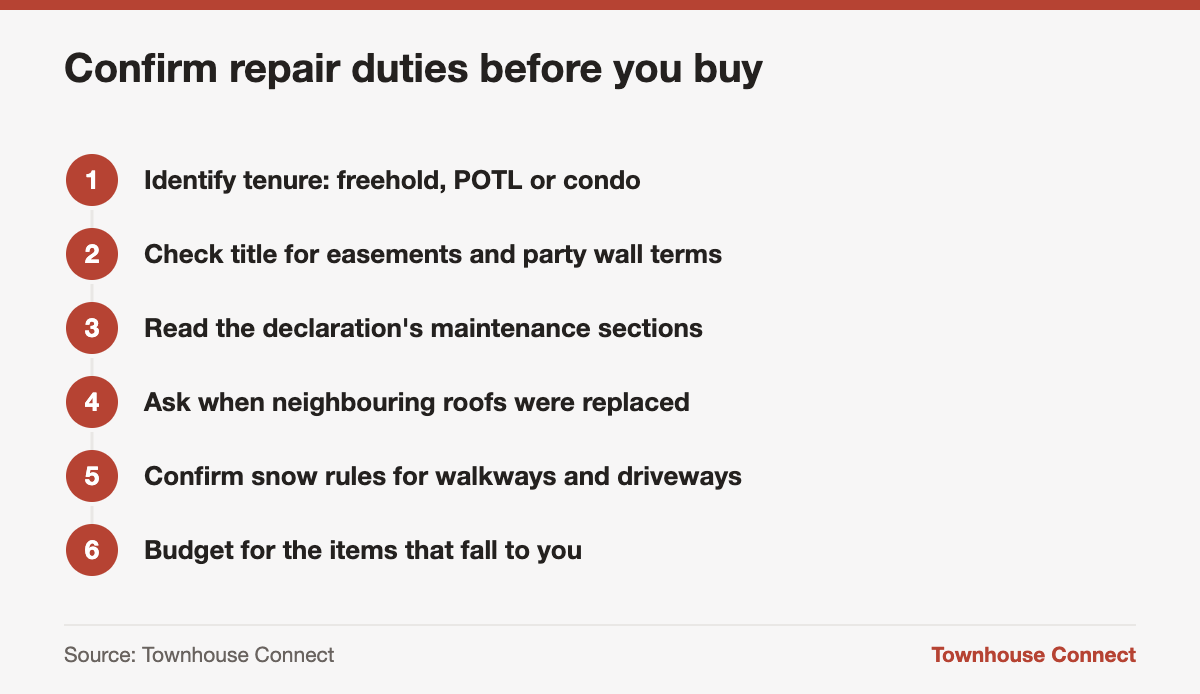
Questions to answer from the declaration
- Who repairs and replaces the roof over your unit?
- Who replaces windows, exterior doors and garage doors?
- Who maintains the driveway, patio, deck and backyard?
- Who clears snow from your walkway and driveway, and by when?
- Do you need approval to change a fence, deck or landscaping?
The answers decide how much you should budget for repairs on top of the fee. They also tie into the reserve fund, which pays for the items the corporation must replace. Our reserve fund checklist shows how to read it.
Who pays when the problem crosses a property line?
Townhouse problems often start in one home and affect another: a leak from a neighbour’s roof, a blocked shared drain, a tree on one lot damaging a fence on the next. A few principles help.
- Damage that one owner causes through negligence is generally that owner’s responsibility, and in condos and POTLs the declaration usually says so.
- Report problems in writing, with photos and dates.
- Call your insurer early. Our post on townhouse insurance explains how claims between attached homes are usually handled.
- For condo issues, go through management and follow the corporation’s process.
For noise and party wall questions specifically, see our post on townhouse noise and party walls.
Frequently asked questions
Who pays to replace the roof on a condo townhouse?
In many Ontario condo townhouse complexes, the corporation replaces roofs and pays from the reserve fund, because roofs are common elements or standard unit elements. But section 91 of the Condominium Act lets the declaration shift repair duties to owners, so check the declaration and the reserve fund study before you buy. The status certificate will show any planned special assessments.
Who shovels snow in a townhouse complex?
In condo and POTL townhouse complexes, the corporation usually plows the private roads and visitor parking, paid through the monthly fee. Walkways, steps and individual driveways vary: some corporations clear them, others leave them to owners. Freehold townhouse owners clear their own driveways and walkways, and municipal rules decide who clears public sidewalks.
What happens if my townhouse neighbour won’t fix their part of the roof?
Start with a written request that explains the problem and any damage to your home, with photos. If the townhouse is a condo, report it to management. For freehold homes, check title for any party wall or maintenance agreement, then consider mediation. If damage continues, speak with your insurer and a lawyer about your options.
Want to know the split before you buy? Browse townhouses and ask us to pull the declaration, survey and easements for any listing you are serious about.
This article is general information as of October 2026, not legal, tax, mortgage or financial advice. Rules and numbers change, so confirm the details for your situation with a licensed professional.