Townhouse insurance in Ontario depends on how you own the home. A freehold or POTL townhouse needs a full homeowners policy that insures the whole building, including your side of the shared walls. A condo townhouse needs a condo unit owner’s policy, because the condo corporation insures the units and common elements against major perils, but not your improvements, belongings, personal liability or, in some cases, the corporation’s deductible.
Key takeaways
- Freehold and POTL owners insure the full rebuilding cost of their townhouse.
- Condo townhouse owners rely on the corporation’s policy for the building, and insure improvements, contents and liability themselves.
- A condo by-law can make owners pay the corporation’s deductible even when no one is at fault, and deductibles can reach tens of thousands of dollars.
- Read the “standard unit” definition: it decides where the corporation’s coverage stops and yours begins.
- Water damage endorsements, such as sewer backup, are worth asking about for any townhouse.
What kind of insurance does a townhouse need?
| Townhouse type | Building insured by | You need |
|---|---|---|
| Freehold | You | Homeowners policy: building, contents, liability, living expenses |
| POTL | You (house); corporation (common elements) | Homeowners policy, plus awareness of the corporation’s coverage |
| Condo townhouse | Condo corporation, up to the standard unit | Condo unit owner’s policy: improvements, contents, liability, deductible and loss assessment coverage |
Insurers sometimes ask “Is it a townhouse or a condo?” as though those were different things. For insurance, what matters is tenure, not shape. A condo townhouse is insured like a condo, and a freehold townhouse is insured like a house.
Insuring a freehold townhouse
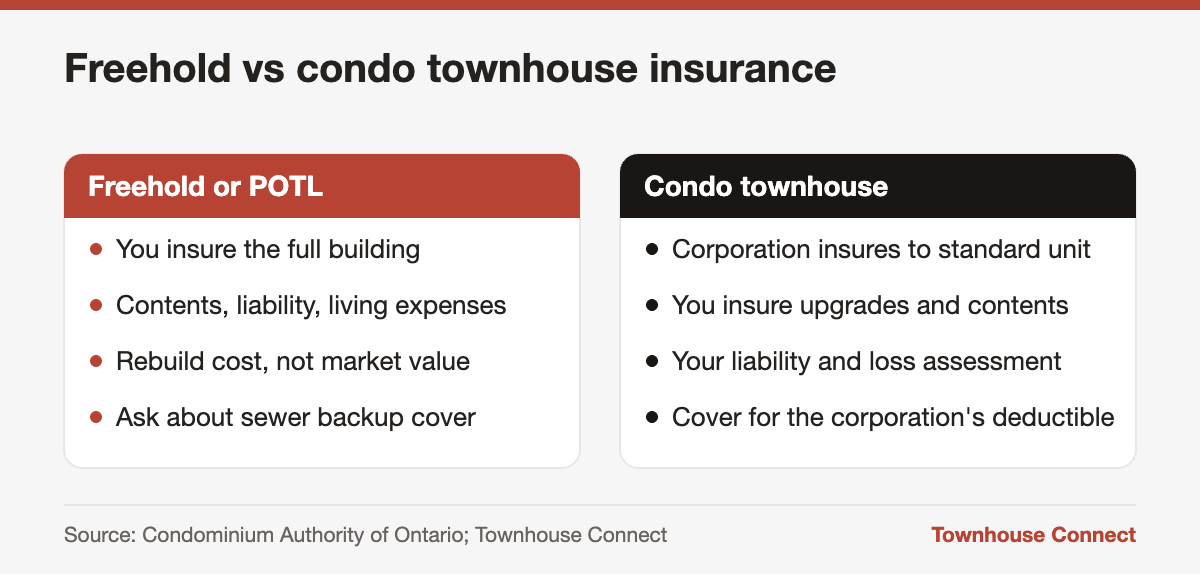
A freehold townhouse owner insures the full structure, from the foundation to the roof, plus contents, liability and additional living expenses if you have to move out during repairs.
The shared-wall question
Your policy covers your home, and your neighbour’s covers theirs. In practice, a fire or water leak that starts next door and spreads into your unit is usually handled by your own insurer, which may then pursue the neighbour’s insurer if the neighbour was at fault. Ask your broker how your policy handles damage that originates in an attached home.
Insure the rebuild cost, not the market value
The building limit should reflect what it would cost to rebuild your townhouse, not what it would sell for. Land does not burn, and in the GTA a large part of a townhouse’s value is land. Ask your insurer how it calculated the replacement cost, and update it after renovations.
Water endorsements
Sewer backup and overland water coverage are often optional add-ons rather than standard. Townhouses with finished basements, especially in older blocks with shared drains, should ask about them specifically.
Insuring a POTL townhouse
A POTL owner owns the house and lot outright, so the insurance looks like a freehold policy. The common elements corporation insures what it owns, such as a private road, visitor parking or shared services, and that insurance is part of the common expenses you pay through your monthly fee. A registered common elements declaration in Caledon lists insurance among those expenses.
Read the declaration for any rules that touch insurance, such as owner responsibility for damage they cause to the common elements. Our POTL townhouse explainer walks through a typical split of duties.
Tip: When you get insurance quotes for a townhouse, tell the broker exactly which type it is: freehold, POTL or condo. A POTL wrongly quoted as a condo policy can leave the building itself uninsured, and a condo townhouse wrongly quoted as a house can mean paying for coverage the corporation already carries.
Insuring a condo townhouse
According to the Condominium Authority of Ontario’s insurance guidance, a condo corporation must carry insurance against damage to the units and common elements from major perils such as fire and flood, liability insurance for the common areas, and directors and officers insurance.
The corporation’s property insurance does not cover improvements or non-standard elements of a unit. Fixtures, furnishings, equipment and personal property are generally not part of a standard unit, so owners insure them separately.
The standard unit definition
Every condo has a definition of a standard unit, either in a by-law or in the description the builder filed when the condo was created. It describes the finishes the corporation is responsible for. If you have upgraded the kitchen, floors or bathrooms beyond that standard, your own policy should cover the difference. In a townhouse condo, ask for the standard unit by-law early, because it varies a lot from one complex to the next.
Deductibles: the expensive surprise
Owners are generally responsible for their own deductibles. Under section 105 of the Condominium Act, 1998, a by-law can also extend an owner’s responsibility for the corporation’s deductible to situations where no one is directly at fault, such as damage that starts in the owner’s unit. The CAO notes deductibles can range from a few hundred dollars to tens of thousands. Many condo unit owner’s policies offer coverage for this; check the limit against the corporation’s actual deductible.
The CAO also explains that the corporation generally repairs common elements and standard unit elements, while owners handle improvements, and that section 91 lets the declaration shift those responsibilities. In a townhouse condo, a shifted duty can apply to items like windows, doors and decks, so read the declaration with your policy in hand. The status certificate includes the corporation’s insurance details.
Questions to ask your insurance broker
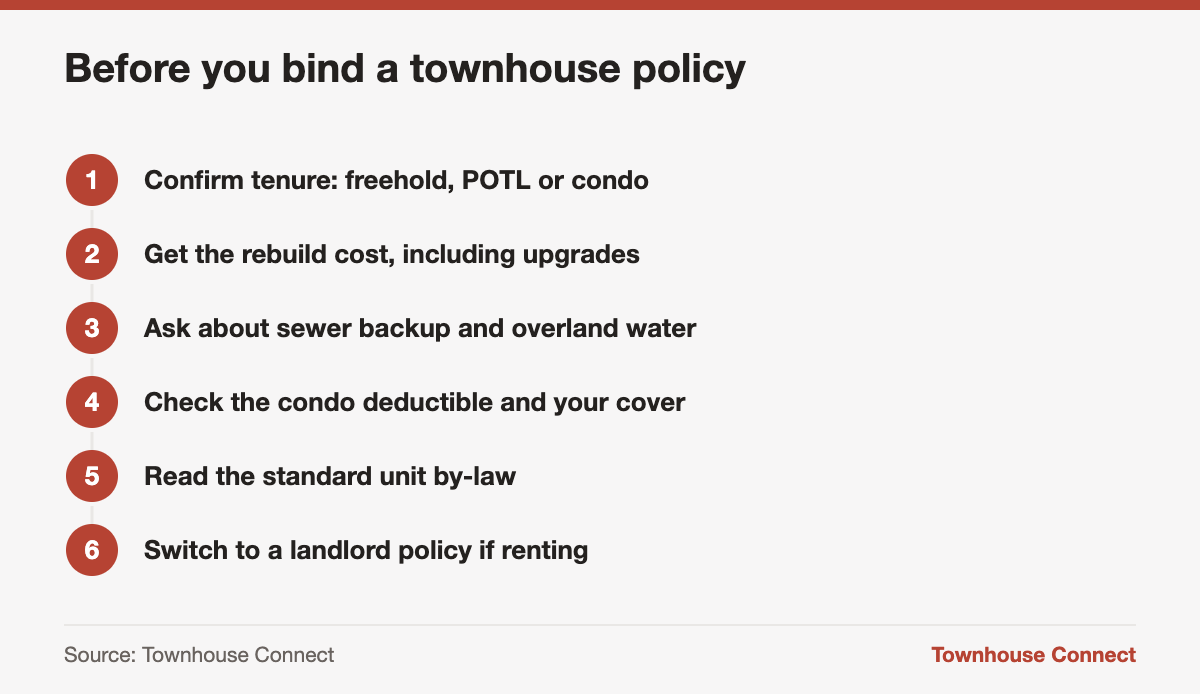
- Is the policy written for the correct tenure: freehold, POTL or condo unit?
- How was the rebuilding cost calculated, and does it include upgrades?
- Does the policy include sewer backup and overland water coverage?
- For condos, what is the corporation’s deductible, and how much deductible coverage do I have?
- Does the policy include loss assessment coverage, for my share of a corporation loss?
- If I rent the townhouse out, do I need a landlord policy instead?
- Are there discounts for a monitored alarm, a newer roof or water leak sensors?
Renting out a townhouse? Change the policy
A standard homeowners or condo owner’s policy assumes you live there. If you rent the townhouse, or add a suite, tell your insurer and switch to a landlord or rented dwelling policy as needed. The CAO notes tenants are not legally required to carry tenant insurance, but a lease or the governing documents may require it. Our post on renting out a townhouse in Ontario covers the landlord side.
Frequently asked questions
Do I need home insurance or condo insurance for a townhouse?
It depends on ownership, not appearance. A freehold or POTL townhouse needs a homeowners policy that insures the full building. A condo townhouse needs a condo unit owner’s policy, because the corporation insures the building against major perils, while you insure improvements, belongings, liability and deductible exposure. The listing, title or status certificate will tell you which you are buying.
Does my condo corporation’s insurance cover my townhouse?
Partly. The corporation insures the units and common elements against major perils, up to the standard unit. It does not cover your improvements beyond that standard, your personal property or your personal liability. It may also charge you its deductible in some situations under a section 105 by-law, so check your own policy’s deductible coverage.
Is a POTL townhouse insured like a condo?
No. With a POTL, you own your house and lot as freehold, so you need a homeowners policy covering the whole building. The common elements corporation insures only what it owns, such as private roads and visitor parking, and that cost is part of your monthly fee. Tell your broker it is a POTL so the policy is written correctly.
Comparing townhouses? Browse townhouse listings and ask us for the declaration, standard unit by-law and insurance certificate before you firm up.
This article is general information as of October 2026, not legal, tax, mortgage or financial advice. Rules and numbers change, so confirm the details for your situation with a licensed professional.