Renting out a townhouse in Ontario is legal and common, but at 2026 prices and rates it rarely pays for itself month to month. TRREB data shows the average GTA townhouse lease was $2,927 a month in Q2 2026, or $3,329 for a three-bedroom. On a benchmark $668,800 townhouse bought with 20% down at about 5.1%, the mortgage alone is roughly $3,140 a month, so most investors are betting on long-term equity, not cash flow. You also take on the full set of Residential Tenancies Act obligations.
Key takeaways
- GTA townhouse rents averaged $2,927 in Q2 2026, about 3.9% lower than a year earlier.
- A rental you will not live in generally needs at least 20% down, and uninsured rates are higher.
- In our example, a condo townhouse runs about $980 a month negative before principal repayment; a freehold, about $580.
- Townhouses first occupied after November 15, 2018 are generally exempt from the rent increase guideline.
- You must use Ontario’s standard lease and can only collect a deposit of up to one month’s rent.
How much rent does a townhouse get in the GTA?
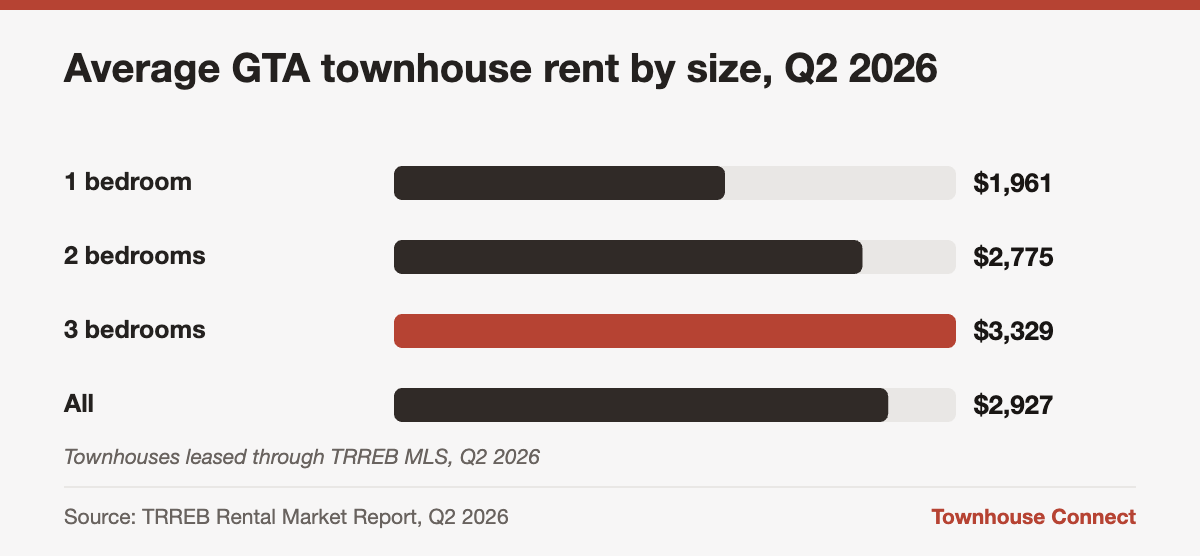
TRREB’s Q2 2026 rental market report covers townhouses leased through its MLS system. Here are the averages across all TRREB areas.
| Townhouse size | Leased Q2 2026 | Average rent Q2 2025 | Average rent Q2 2026 | Change |
|---|---|---|---|---|
| 1 bedroom | 150 | $2,221 | $1,961 | −11.7% |
| 2 bedrooms | 647 | $2,836 | $2,775 | −2.1% |
| 3 bedrooms | 628 | $3,449 | $3,329 | −3.5% |
| All townhouses | 1,432 | $3,046 | $2,927 | about −3.9% |
Rents have softened alongside prices, and tenants have more choice than they did in 2023. Townhouses still rent well to families who want more space than a condo apartment, especially near schools and transit.
Is a townhouse a good rental investment in 2026?
Here is a worked example on a townhouse at the GTA benchmark of $668,800. Assumptions are labelled; swap in your own.
- Down payment: 20%, or $133,760
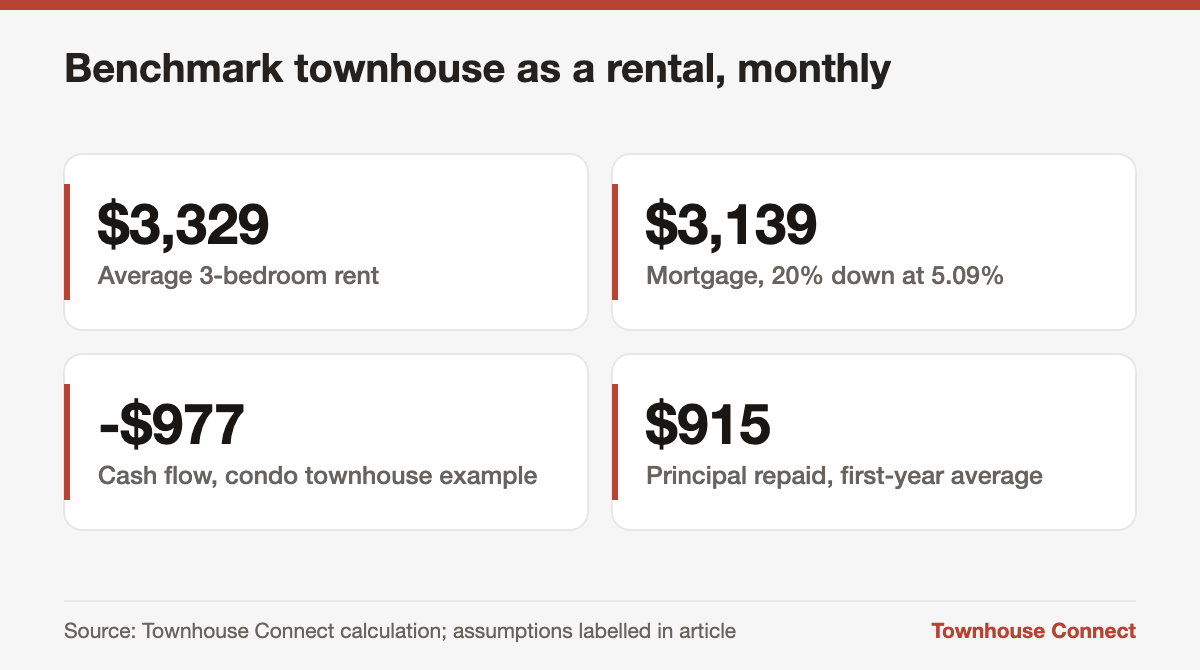
- Mortgage: $535,040 at 5.09% over 25 years = about $3,139 a month
- Rent: $3,329 a month, the Q2 2026 average for a three-bedroom
- Property tax: $400 a month (assumption)
- Condo fee: $400 a month (assumption; $0 for freehold)
- Landlord insurance: $100 a month (assumption)
- Maintenance reserve: 5% of rent; vacancy allowance: 3% of rent
| Monthly | Condo townhouse | Freehold townhouse |
|---|---|---|
| Rent | $3,329 | $3,329 |
| Mortgage payment | −$3,139 | −$3,139 |
| Tax, fee, insurance, maintenance, vacancy | −$1,166 | −$766 |
| Cash flow | about −$977 | about −$577 |
Part of the mortgage payment is principal, not cost. In the first year, about $10,970 of payments, or roughly $915 a month, goes to reducing the loan. So the condo townhouse in this example is close to break-even on an equity basis, before any price change, and the freehold builds a little. The gross yield, annual rent divided by price, is about 6.0%.
That is the honest picture in 2026: GTA townhouse rentals are generally a long-term equity play with negative monthly cash flow at current rates, unless you put down much more than 20% or buy well below the benchmark. Our guide to the most affordable GTA suburbs shows where entry prices are lower.
Rent control rules for townhouse landlords
Ontario’s guideline caps annual increases for most existing tenancies at 2.1% for 2026 and 1.9% for 2027. Under the province’s rent increase rules, units in new buildings and additions first occupied for residential purposes after November 15, 2018 are exempt from the guideline.
That exemption matters for townhouses. A townhouse completed in 2019 or later is generally exempt, while one first occupied before November 16, 2018 is subject to the guideline for sitting tenants. Either way, you must wait 12 months between increases and give at least 90 days’ written notice on the proper Landlord and Tenant Board form.
Tip: When comparing two townhouses as rentals, check the year each was first occupied. A 2017 townhouse and a 2020 townhouse may look the same, but only the newer one is exempt from the rent increase guideline. Over a long tenancy, that difference can matter more than a small gap in purchase price.
Your obligations as a landlord in Ontario
- Use the standard lease. Most private residential tenancies must use Ontario’s standard lease form.
- Limit the deposit. You can collect a rent deposit of no more than one month’s rent, used only for the last month. You must pay interest on it each year at the guideline rate. Damage deposits are not allowed.
- Do not require post-dated cheques. Tenants can agree to them, but you cannot insist.
- Keep the home in good repair. That includes meeting municipal standards and not interfering with heat from September 1 to June 15.
- Follow the rules for ending a tenancy. Notice must be on the proper Landlord and Tenant Board form, and a tenant does not have to leave without an LTB order.
If you or a family member want to move in, you must give the proper notice. The province’s renting rights page says you must pay the tenant one month’s rent or offer another unit, unless you gave 120 days’ notice or more.
Condo townhouse and POTL rental rules
Condo declarations and rules can regulate leasing, so read them before you buy. Expect to provide lease details and tenant information to management, and make sure your tenant receives the rules. Short-term rentals are a different matter: many condo rules prohibit them.
In Toronto, short-term rentals are allowed only in the operator’s principal residence, with a $390 registration fee for 2026 and a 6% Municipal Accommodation Tax. A townhouse you bought as an investment cannot be run as a short-term rental in the city.
Before buying a condo or POTL townhouse to rent, read the declaration and rules, and check the reserve fund health. Our reserve fund checklist covers what to look for.
Taxes on a rented townhouse
- Report rental income and expenses on Form T776. Interest, property tax, insurance, condo fees and repairs are generally deductible.
- When you sell, any gain on a property that was never your principal residence is a capital gain, with one-half included in income. The proposed increase to two-thirds was cancelled in March 2025.
- In Toronto, a home left vacant can face the Vacant Home Tax at 3% of assessed value; declarations are due April 30 each year.
An accountant who works with landlords can help you structure this, including how a suite in your own home is treated. Our post on adding a basement suite to a townhouse covers that alternative.
Frequently asked questions
How much can I rent my townhouse for in Toronto?
Across all TRREB areas, townhouses leased for an average of $2,775 for two bedrooms and $3,329 for three bedrooms in Q2 2026. Rents vary by neighbourhood, and size, condition, parking and transit access all matter. Compare recent leases of similar townhouses nearby before setting your price.
Can I raise the rent on my townhouse every year?
You can raise rent once every 12 months with at least 90 days’ written notice on the proper form. If the townhouse was first occupied before November 16, 2018, the increase is capped at the guideline: 2.1% for 2026 and 1.9% for 2027. Newer units are generally exempt from the cap.
Do I need 20% down to buy a townhouse as a rental?
Generally yes. Mortgage default insurance for small down payments is designed for homes the buyer will live in, so a pure rental usually needs at least 20% down. Uninsured rates were around 5.1% in mid-October 2026. If you will live in part of the townhouse and rent a legal suite, lower down payments may be possible.
Weighing a townhouse as a rental? Browse GTA townhouses for sale and ask us for recent lease comparables before you buy.
This article is general information as of October 2026, not legal, tax, mortgage or financial advice. Rules and numbers change, so confirm the details for your situation with a licensed professional.