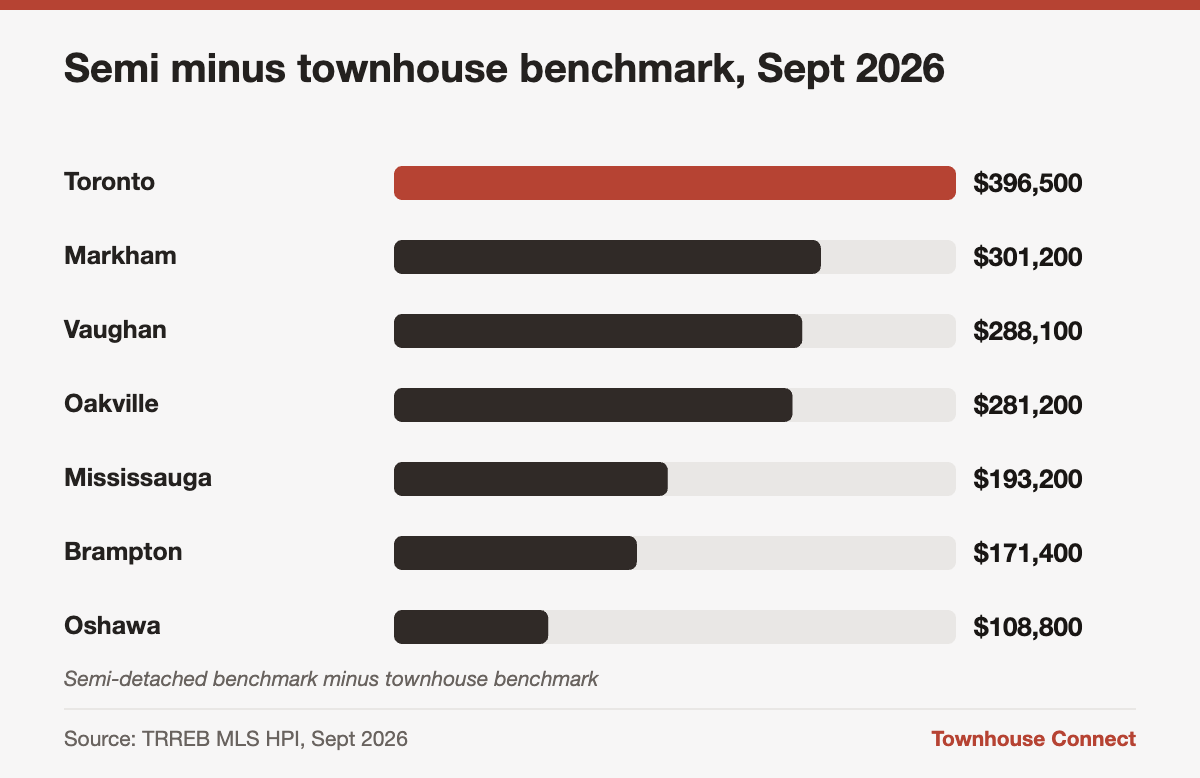
In September 2026 the typical GTA townhouse cost $243,200 less than the typical semi-detached house: TRREB’s MLS HPI benchmark was $668,800 for townhouses and $912,000 for semis across all TRREB areas. In the City of Toronto the gap widens to $396,500, while in Oshawa it shrinks to $108,800. Townhouse prices also fell faster over the past year, down 6.52% versus 4.83% for semis.
Key takeaways
- A benchmark GTA townhouse is about 27% cheaper than a benchmark semi-detached house.
- The gap ranges from $108,800 in Oshawa to $396,500 in the City of Toronto.
- Freehold townhouses sell much closer to semis on average price than the benchmarks suggest.
- Semis are selling faster and nearer to asking than townhouses this fall.
- At 4.34%, the GTA gap is worth about $1,320 a month in mortgage payments.
How much cheaper is a townhouse than a semi in the GTA?
The cleanest comparison uses TRREB’s MLS Home Price Index, which tracks the price of a “benchmark” home with typical features in each area. Because it adjusts for size and features, it is less distorted by a few large sales than the average price is.
Here are the September 2026 benchmarks from TRREB’s MLS HPI tables. TRREB reports semis under its “single-family attached” category.
| Area | Townhouse benchmark | Semi-detached benchmark | Gap | Townhouse discount |
|---|---|---|---|---|
| All TRREB areas | $668,800 | $912,000 | $243,200 | 26.7% |
| City of Toronto | $714,700 | $1,111,200 | $396,500 | 35.7% |
| Markham | $731,700 | $1,032,900 | $301,200 | 29.2% |
| Vaughan | $747,300 | $1,035,400 | $288,100 | 27.8% |
| Oakville | $700,000 | $981,200 | $281,200 | 28.7% |
| Mississauga | $677,500 | $870,700 | $193,200 | 22.2% |
| Brampton | $583,100 | $754,500 | $171,400 | 22.7% |
| Oshawa | $489,300 | $598,100 | $108,800 | 18.2% |
The pattern is consistent: the more expensive the area, the bigger the dollar gap. In the City of Toronto, a benchmark semi costs 55% more than a benchmark townhouse.
Benchmark vs average price: why the gap looks different
TRREB’s September 2026 Market Watch also reports average sale prices, and it splits townhouses into freehold (attached/row) and condo townhouses. That changes the picture.
| Home type, all TRREB areas | September 2026 average price | Sales |
|---|---|---|
| Semi-detached | $1,015,202 | 459 |
| Freehold townhouse (att/row) | $907,849 | 448 |
| Condo townhouse | $710,579 | 355 |
| All townhouses combined | $820,637 | 803 |
On averages, a freehold townhouse sold for only about $107,000 less than a semi. In the City of Toronto, freehold townhouses averaged $1,104,629 against $1,207,884 for semis.
Two things explain it. First, averages reflect whatever happened to sell that month, and the freehold townhouses that traded may be larger or newer than TRREB’s typical benchmark home. Second, condo townhouses, which are generally smaller and carry monthly fees, pull the combined townhouse numbers down. When someone quotes “townhouse prices,” ask which kind they mean.
Townhouse vs semi-detached: which is falling faster in 2026?
Both are down from a year ago, but townhouses have softened more.
- Townhouse benchmark: down 6.52% year over year across all TRREB areas, and down 5.04% in the City of Toronto.
- Semi-detached benchmark: down 4.83% across all TRREB areas, and down 4.94% in Toronto.
Some 905 municipalities saw steeper townhouse declines. Whitby’s townhouse benchmark fell 13.31% and Newmarket’s fell 9.68%, while Pickering’s dropped 4.22%. Local conditions, such as how many listings are competing for the same buyers, drive much of that spread.
Which sells faster: a townhouse or a semi?
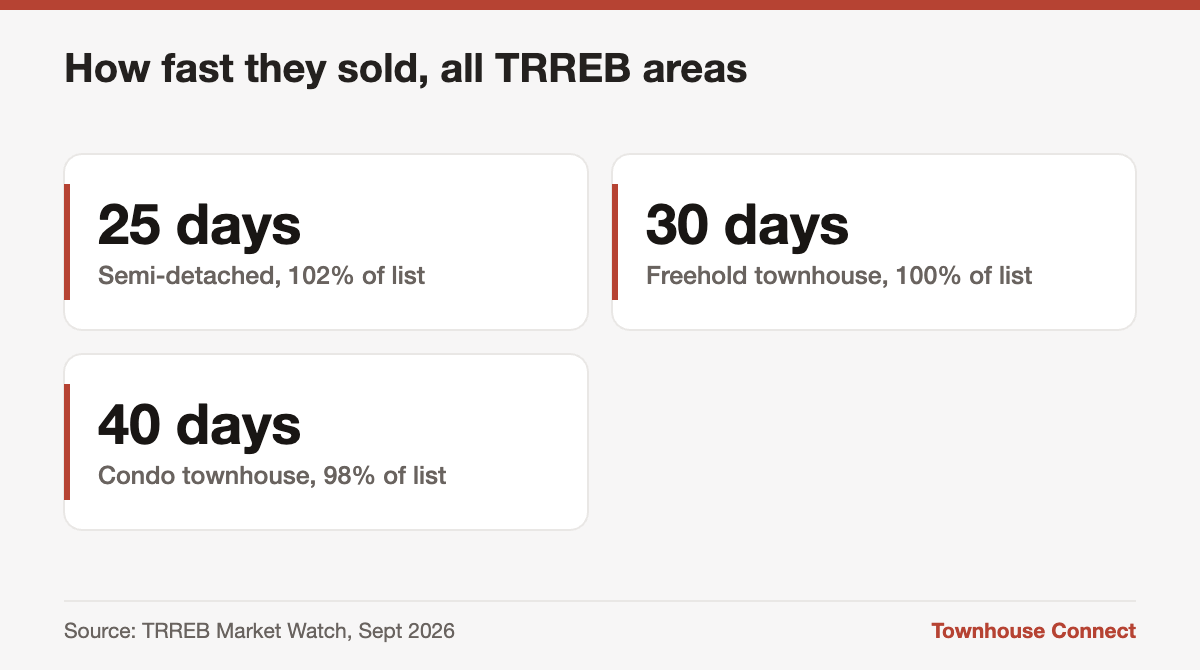
Semis currently move faster and closer to asking. In September, semis across TRREB sold in an average of 25 days on market at 102% of list price. Freehold townhouses averaged 30 days at 100% of list, and condo townhouses 40 days at 98% of list.
For buyers, that means condo townhouses offer the most room to negotiate this fall. For sellers, it means pricing a condo townhouse realistically from the first day matters more than it did in 2022. Our recent sold prices tool shows what similar homes actually fetched.
Is a semi worth the extra money over a townhouse?
There is no universal answer, but the trade-offs are concrete.
What the extra money buys with a semi
- One shared wall instead of two (for an interior townhouse).
- Usually a freehold lot with no monthly fees.
- Often a side yard or side entrance, which can make a basement suite easier.
- Typically more land, which historically has driven long-term appreciation.
What you keep by choosing a townhouse
- A smaller down payment: the minimum on a $668,800 home is $41,880, versus $66,200 on a $912,000 semi.
- Lower monthly payments: at 4.34% over 25 years, the $243,200 GTA gap is worth about $1,324 a month.
- Newer construction in many 905 neighbourhoods, with less immediate repair risk.
- In condo and POTL townhouses, someone else plows the road and maintains shared areas.
Property tax usually runs higher on the semi as well, because it is based on assessed value, and insuring a larger house generally costs more. Condo townhouse fees work the other way, adding a monthly cost the semi owner does not pay but covering items the semi owner budgets for separately, like roofing and snow removal.
The monthly figure is the one to sit with. Roughly $1,300 a month is a car payment, a daycare bill or a healthy RRSP contribution. Our post on the October 28 rate decision shows how quickly rate changes move that number.
Tip: If you are torn between a semi and an end-unit freehold townhouse, compare them on price per square foot of finished space and on lot frontage, not just the list price. An end unit often has a side yard and windows on three sides, which narrows the lifestyle gap with a semi at a lower price.
Where the townhouse vs semi gap is smallest
If you want the most house for the least premium, look where the dollar gap is small. In Oshawa the gap was $108,800 and in Ajax $145,900. In those cities, stretching from a townhouse to a semi is a smaller jump than in Toronto or York Region. Our Mississauga and Markham market reports have more local detail, and Oshawa townhouse listings show what sub-$500,000 options look like today.
Frequently asked questions
Is a townhouse a good investment compared with a semi-detached house?
Both can be. Semis usually include more land, which has historically supported appreciation, and they currently sell faster. Townhouses cost less to buy and carry, so more of your budget stays free for savings. Over the past year the townhouse benchmark fell 6.52% versus 4.83% for semis across TRREB, but one year says little about the next ten.
What is the difference between the benchmark price and the average price?
The benchmark price is TRREB’s estimate of what a typical home with standard features would sell for, so it adjusts for changes in the mix of homes sold. The average price is simply total sales value divided by number of sales. Averages jump around when bigger or smaller homes happen to sell in a given month.
Are freehold townhouses cheaper than semis in Toronto?
Yes, but by less than many buyers expect. In September 2026, freehold townhouses in the City of Toronto averaged $1,104,629 compared with $1,207,884 for semi-detached homes, a gap of about $103,000. Condo townhouses averaged $749,653, which is where the big savings are. The right comparison depends on size, location and condition.
Why are townhouse prices falling faster in the 905 than in Toronto?
TRREB’s Market Watch shows the combined average townhouse price fell 5.8% year over year in the 905 regions in September 2026, compared with 0.8% in the City of Toronto. The benchmark tells a similar story: down 5.04% in Toronto against 6.52% for all TRREB areas. Steep drops in places like Whitby and Newmarket pull the regional figures down, though the data does not point to a single cause.
Want to see how the numbers look on your street? Search townhouses across the GTA, or try our townhouse value estimate if you already own one and are thinking about moving up.
This article is general information as of October 2026, not legal, tax, mortgage or financial advice. Rules and numbers change, so confirm the details for your situation with a licensed professional.