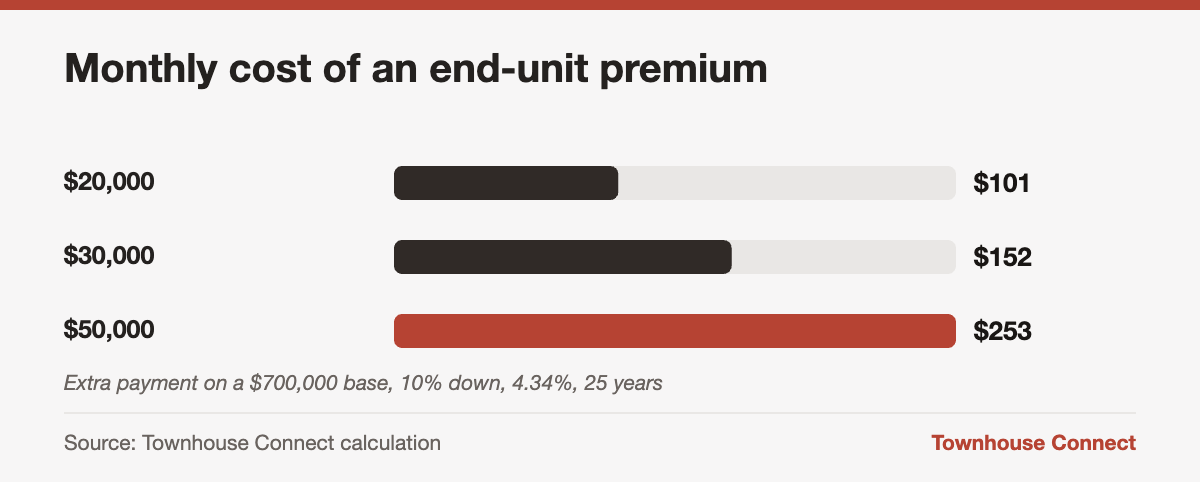
An end unit townhouse is usually worth a premium if you value light, privacy from neighbours and outdoor space, because it has one shared wall instead of two, windows on three sides and often a side yard. There is no published GTA-wide figure for the end-unit premium, so the right price comes from comparing end and interior sales in the same complex. As a guide to cost, every $30,000 of premium on a $700,000 townhouse adds about $150 a month to a 10%-down mortgage at 4.34%.
Key takeaways
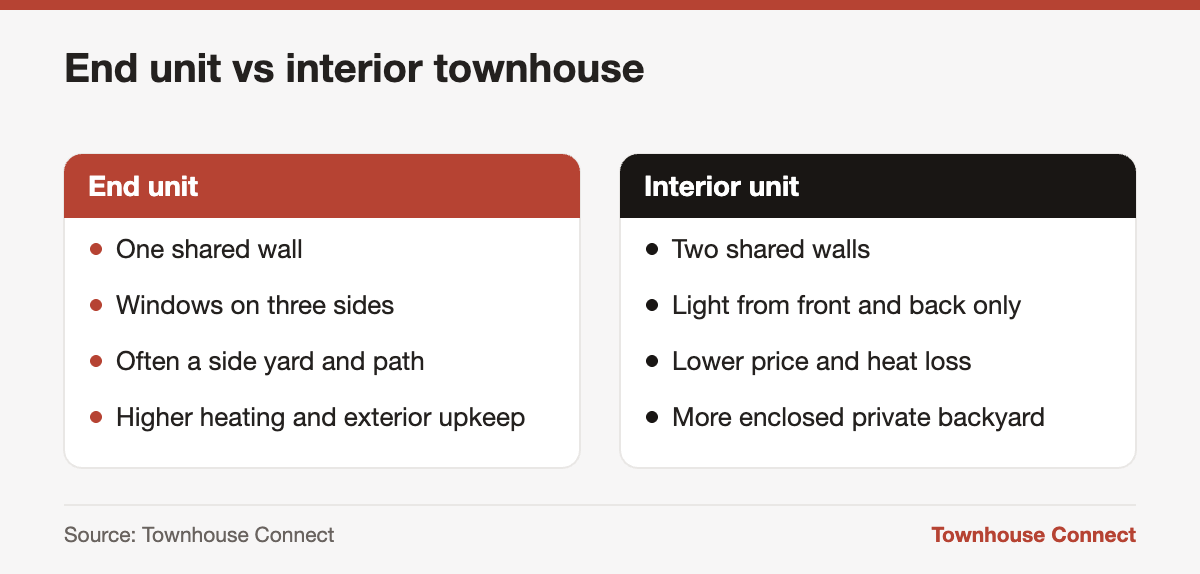
- End units trade a second shared wall for windows on three sides, and often a side yard.
- The premium varies by complex, so judge it against recent end-unit and interior sales nearby.
- A $30,000 premium costs about $150 a month on a 10%-down insured mortgage, plus $3,000 more down.
- Expect somewhat higher heating, more exterior upkeep and possibly a higher condo fee or property tax.
- End units can make a basement suite easier, because a side path can reach a separate entrance.
What makes an end unit townhouse different?
An end unit sits at the end of a row or block, so it shares only one wall. That simple fact changes how the home lives.
- Light: an extra exterior wall usually means side windows, which can transform a narrow townhouse floor plan.
- Noise: one set of neighbours instead of two. Our post on townhouse noise and party walls explains why that matters.
- Space: many end units sit on wider lots with a side yard, and in some new communities builders design end units with their own, sometimes larger, floor plans.
- Access: a side path to the backyard means you do not have to carry the lawnmower through the kitchen.
In back-to-back blocks the difference is even bigger. An interior back-to-back has windows on one face only, so an end unit can be the difference between a bright home and a dim one. Our comparison of stacked, back-to-back and row townhouses covers that in detail.
How much more does an end unit townhouse cost?
Be wary of anyone quoting a fixed percentage. TRREB’s price data does not separate end units from interior units, and the premium depends heavily on the specific complex: lot width, floor plan differences, what the side wall faces and how many end units are for sale at the time.
The reliable way to price it is to look at actual sales in the same development.
- Find recent sales in the complex or on the street. Our townhouse sold prices tool and street match tool help.
- Separate end units from interior units. Note the sale date of each, since prices have moved over the past year.
- Adjust for size. If the end unit is larger, compare price per square foot as well as total price.
- Adjust for condition. A renovated interior unit can sell for more than a dated end unit.
- Look at what the side faces. A side yard on a quiet walkway is worth more than one beside a busy road or a parking lot.
What an end unit premium costs per month
Here is what different premiums add on top of a $700,000 townhouse, with 10% down, CMHC insurance added to the loan, and a 4.34% rate over 25 years.
| End-unit premium | Extra down payment | Extra insured mortgage | Extra monthly payment | Extra Ontario LTT |
|---|---|---|---|---|
| $20,000 | $2,000 | $18,558 | about $101 | $400 |
| $30,000 | $3,000 | $27,837 | about $152 | $600 |
| $50,000 | $5,000 | $46,395 | about $253 | $1,000 |
In the City of Toronto, double the land transfer tax figure, since the municipal tax matches the provincial one at this price. Our land transfer tax guide has the full brackets.
The hidden costs of an end unit
Heating and cooling
An interior townhouse is insulated on both sides by its neighbours’ heated homes. An end unit has a full exterior wall, so it loses more heat in winter and gains more in summer. Ask the sellers for a year of utility bills and compare them with an interior unit if you can.
Exterior maintenance
A freehold end-unit owner maintains an extra wall of brick or siding, extra windows and often a longer stretch of fence. On a corner lot, there may be more sidewalk or walkway to clear of snow, depending on your municipality’s rules.
Fees and property tax
In a condo townhouse, fees are usually set by each unit’s proportionate share in the declaration, which often reflects size. A larger end unit may carry a higher fee. For freehold and POTL homes, a larger lot or house can mean a higher assessment and property tax. MPAC assessments for 2026 taxes are still based on January 1, 2016 values.
Privacy and security
Side windows let in light, and also views from passers-by. A side yard facing a public path is less private than an enclosed interior backyard. Some owners add a taller fence or frosted glass on the side.
Tip: If you plan to add a basement suite one day, an end unit is often the strongest candidate in a townhouse row. The side yard can give a tenant a separate route to a rear or side entrance, which is the hardest problem to solve in an interior unit. Our post on basement suites in townhouses explains the rules.
Is an end unit a better investment?
It depends on what you pay. The features buyers value in end units, such as light, one shared wall and a side yard, do not wear out, so they should appeal to the next buyer too. That makes a fair premium more likely to be recovered at resale. Overpaying is the risk. If you pay far more than recent end-unit sales in the same complex, the next buyer will compare your price with theirs.
In today’s slower market, you also have more room to negotiate. GTA freehold townhouses sold at an average of 100% of list price in September 2026, and condo townhouses at 98%, according to TRREB’s September 2026 Market Watch, with 30 and 40 average days on market respectively.
End unit vs interior unit: quick comparison
- Choose an end unit if: light matters, you want a side yard or easier backyard access, you work from home and want fewer neighbours, or you may add a suite.
- Choose an interior unit if: you want the lowest price and heating bills, prefer an enclosed private backyard, or would rather spend the premium on renovations.
Frequently asked questions
Is an end unit townhouse worth it?
For many buyers, yes. You get one shared wall instead of two, windows on three sides and often a side yard. Whether it is worth it depends on the premium compared with recent sales in the same complex, and on costs like heating and exterior upkeep. A fair premium is more likely to be recovered when you sell.
Do end unit townhouses cost more to heat?
Generally, yes. An interior unit is sheltered by heated homes on both sides, while an end unit has a full exterior wall that loses heat in winter and gains it in summer. The difference depends on insulation, windows and orientation. Ask the sellers for recent utility bills and compare them with an interior unit if possible.
Are end unit townhouses easier to sell?
They have features that appeal to many buyers, such as extra light and fewer shared walls, which can help. But price still decides how fast any townhouse sells. In September 2026, GTA freehold townhouses averaged 30 days on market and condo townhouses 40 days. An end unit priced well above comparable sales can still sit.
Looking for an end unit? Search GTA townhouses or try the townhouse swipe tool to compare end and interior units quickly.
This article is general information as of October 2026, not legal, tax, mortgage or financial advice. Rules and numbers change, so confirm the details for your situation with a licensed professional.
The newest townhouses on the market
Fresh listings, updated every 15 minutes.
 $475,000366 Chaffey Street, Welland3 bed · 2 bath · Lincoln/CrowlandCourtesy of ZOWN REALTY INC.
 $729,00068 - 39 Crab Appleway Way, Toronto3 bed · 2 bath · Parkwoods-DonaldaCourtesy of CENTURY 21 PERCY FULTON LTD.
 $384,9002603 PIMLICO Crescent, Blossom Park - Airport and Area3 bed · 2 bath · Emerald Woods/Sawmill CreekCourtesy of ROYAL LEPAGE PERFORMANCE REALTY
 $529,000Th112 - 36 Lee Centre Drive, Toronto2 bed · 2 bath · WoburnCourtesy of RIGHT AT HOME REALTY
 $819,0008 Zezel Way, Toronto3+2 bed · 4 bath · Dorset ParkCourtesy of DREAM VALLEY REALTY INC.
 $989,9906 Upper Paradise Way, Whitby4 bed · 3 bath · Rural WhitbyCourtesy of PIVOT REAL ESTATE GROUP