
Selling a townhouse in the GTA this fall takes sharper pricing and better preparation than it did a few years ago. In September 2026 there were about 5.9 months of condo townhouse inventory and 4.1 months of freehold townhouse inventory across TRREB, with condo townhouses selling at an average of 98% of list after 40 days. To sell well, price off recent sold comparables, have your status certificate and disclosure ready on day one, and fix the objections buyers raise about townhouses before they see them.
Key takeaways
- Freehold townhouses are selling faster than condo townhouses: 30 days at 100% of list versus 40 days at 98%.
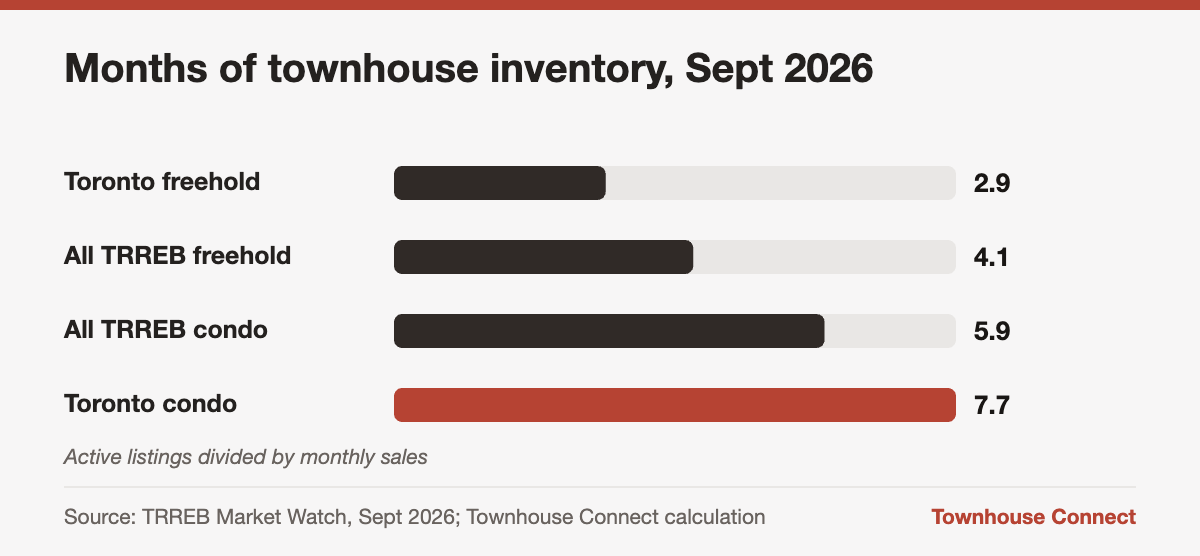
- In the City of Toronto, freehold townhouses are tight (about 2.9 months of inventory) while condo townhouses are slow (about 7.7 months).
- Overpricing is expensive: the longer a listing sits, the more buyers assume something is wrong.
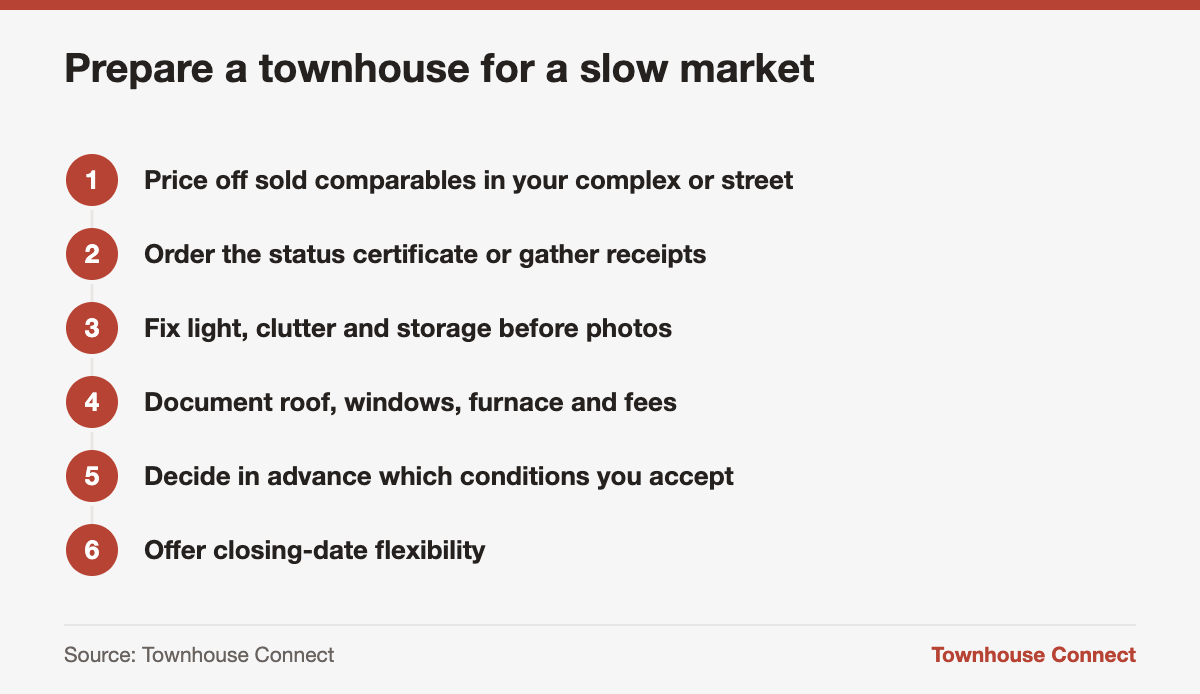
- For condo and POTL townhouses, order the status certificate before listing.
- Answer the townhouse questions up front: shared-wall noise, fees, parking, roof age and reserve fund health.
Is it a buyer’s market for townhouses in the GTA?
For most townhouses, yes. TRREB’s September 2026 Market Watch shows the supply side clearly.
| September 2026 | Freehold townhouse | Condo townhouse |
|---|---|---|
| Sales (all TRREB) | 448 | 355 |
| New listings | 1,351 | 1,278 |
| Active listings | 1,854 | 2,097 |
| Months of inventory (active / sales) | 4.1 | 5.9 |
| Average days on market | 30 | 40 |
| Sale price as % of list | 100% | 98% |
| Median price | $837,000 | $659,000 |
A useful rule of thumb is the sales-to-new-listings ratio. Below roughly 40% usually signals a buyer’s market. Freehold townhouses came in at about 33% and condo townhouses at about 28% in September. Combined townhouse sales were down 12.8% from a year earlier, and the combined average price was down 4.6%.
Toronto is two markets
Inside the City of Toronto, the split is stark. Freehold townhouses had 92 sales against 267 active listings, about 2.9 months of supply, and sold at 102% of list on average. Condo townhouses had 97 sales against 747 active listings, about 7.7 months, and sold at 98% of list. A freehold row house in the city can still draw competition; a condo townhouse in a large complex with many similar units for sale will not.
How to price a townhouse when buyers have choices
Pricing is where most sellers win or lose in a slower market. Buyers today can see a dozen alternatives, and they know which ones have sat.
- Use sold prices, not asking prices. Asking prices tell you what other sellers hope for. Our townhouse sold prices tool shows what buyers actually paid.
- Compare within your complex or street first. In townhouse communities, the best comparable is often a near-identical unit a few doors away. Our street match tool helps find them.
- Adjust for the things buyers pay for. End unit, finished basement, garage, renovated kitchen, backing onto green space, and for condos, fee level and parking.
- Price for the first two weeks. A listing gets the most attention when it is new. If you start 5% high and cut later, you have used up that window.
- Check the overlap. If five similar townhouses are listed, buyers will compare yours directly on price per square foot.
For a quick starting point, our townhouse value estimate gives a range you can refine with an agent’s comparables.
Tip: In a complex where several similar units are for sale, watch what sells and how fast. If a comparable unit sells below its asking price while yours is being prepared, adjust before you list rather than after. Being the best value among identical townhouses is the fastest way to sell in a slow condo townhouse market.
Get the paperwork ready before you list
Paperwork delays kill deals in a buyer’s market, because buyers have other options while they wait.
Condo and POTL townhouses
Order the status certificate before you list. Under Condominium Authority of Ontario rules, the fee is capped at $100 including taxes and the corporation has up to 10 days to deliver it. Having it on hand lets a buyer’s lawyer review it in a day or two, so you can accept a shorter condition period. Read it yourself first so you are not surprised by a special assessment, a reserve fund shortfall or a pending fee increase.
Freehold townhouses
Gather receipts for the roof, windows, furnace, air conditioner and any waterproofing, plus permits for renovations. For a townhouse with a shared roof, note when your section was last replaced and whether neighbours have replaced theirs. Buyers ask about it.
Answer the townhouse objections before buyers raise them
- Noise through shared walls: if your unit is quiet, say so, and let buyers visit at different times of day.
- Fees: show what the condo or POTL fee covers. A fee that includes roofs, windows and snow removal compares well with a freehold owner’s repair budget.
- Parking: be clear about the garage, driveway, tandem spaces and visitor parking rules.
- Stairs and storage: declutter hard. Townhouse floors are narrow, and buyers need to see wall space and storage.
- Light: clean windows, open blinds and replace dim bulbs, especially in back-to-back units.
Should you wait until spring to sell?
Spring markets usually bring more buyers, but also more listings. Waiting makes sense if you have no deadline and your home will show better with a garden. It makes less sense if you are paying two sets of carrying costs, or if rates move against buyers. The Bank of Canada announces decisions on October 28 and December 9, and our post on what the October 28 decision means for buyers explains how rate changes shift buyer budgets.
If you are also buying, coordinate both sides. Many move-up sellers in a buyer’s market sell first, so they negotiate their purchase with firm equity in hand.
Negotiating offers in a slower market
Expect conditional offers again. Inspection and financing conditions are more common again when buyers have plenty of choice, and a buyer who can write a firm offer will expect a better price for it. Decide in advance which conditions you will accept and how long a condition period you can live with.
Flexibility on closing dates can be worth more than a few thousand dollars on price, especially to buyers who need to sell first or are waiting for a lease to end. On a $700,000 townhouse, the gap between selling at 98% and 100% of list is $14,000, which is why the right list price matters more than any negotiation trick. Our townhouse seller’s guide covers each step from listing to closing.
Frequently asked questions
How long does it take to sell a townhouse in the GTA?
In September 2026, freehold townhouses across TRREB sold in an average of 30 days on market and condo townhouses in 40 days, according to TRREB. In the City of Toronto, freehold townhouses averaged 23 days and condo townhouses 39 days. A well-priced, well-prepared townhouse can sell faster; an overpriced one can sit for months.
Should I lower my price if my townhouse is not selling?
If you have had showings but no offers after two or three weeks, the market is telling you the price is high relative to alternatives. Compare your home with townhouses that have sold, not just listed, since you went on the market. A meaningful reduction early usually beats several small cuts spread over months.
Do I need a status certificate to sell my condo townhouse?
You are not required to provide one before listing, but buyers almost always make their offer conditional on reviewing it. Ordering it in advance costs at most $100 and avoids a 10-day wait after you accept an offer. It also lets you spot issues like special assessments or legal actions before a buyer does.
Thinking about selling? Start with a townhouse seller consultation and a pricing review based on recent sales on your street.
This article is general information as of October 2026, not legal, tax, mortgage or financial advice. Rules and numbers change, so confirm the details for your situation with a licensed professional.