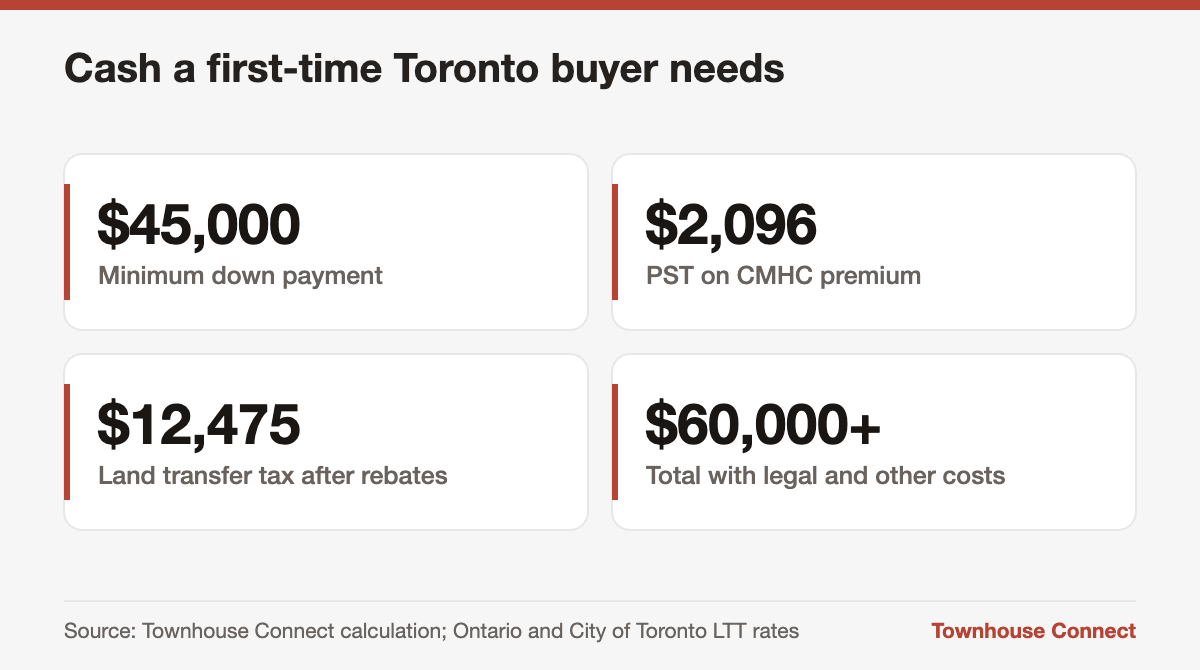
The minimum down payment on a $700,000 townhouse in Ontario is $45,000: 5% of the first $500,000 ($25,000) plus 10% of the remaining $200,000 ($20,000). That works out to about 6.4% of the price. Because it is under 20%, you will also pay a CMHC insurance premium of about $26,200, added to the mortgage, plus $2,096 in Ontario sales tax on that premium, which must be paid in cash at closing.
Key takeaways
- Minimum down on a $700,000 townhouse: $45,000, or about 6.4%.
- Below 20% down, CMHC premiums run from 2.80% to 4.00% of the loan, and the 8% PST on the premium is due in cash.
- A first-time buyer in Toronto needs about $12,475 for land transfer tax after rebates; outside Toronto, about $6,475.
- A couple can tap up to $80,000 from FHSAs and $120,000 from the RRSP Home Buyers’ Plan.
- At today’s rates, 20% down can produce almost the same payment as 15% down, because insured mortgages get lower rates.
How much down payment do you need for a $700,000 townhouse?
Federal rules for insured mortgages set the minimum on a sliding scale. You need 5% on the portion of the price up to $500,000 and 10% on the portion from $500,000 to $1.5 million. Homes of $1.5 million or more cannot be insured, so they need 20% down. CMHC’s purchase program rules set out the details.
For a $700,000 townhouse, the math is:
- 5% of $500,000 = $25,000
- 10% of $200,000 = $20,000
- Total minimum down payment = $45,000
The figure is the same whether the townhouse is freehold, POTL or condo. A $700,000 price sits close to TRREB’s September 2026 townhouse benchmarks for the City of Toronto ($714,700) and the GTA ($668,800).
Four down payment scenarios on a $700,000 townhouse
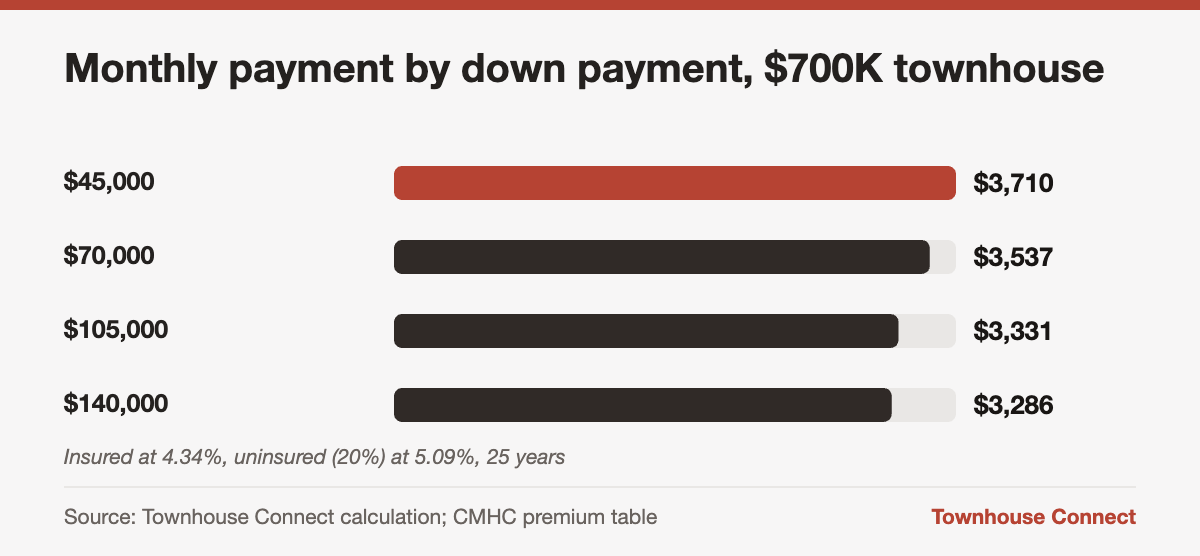
The table below compares common down payment levels. Insured payments use a 4.34% five-year fixed rate and uninsured use 5.09%, both roughly where the best Ontario rates sat on October 15, 2026. All use a 25-year amortization.
| Down payment | CMHC premium | PST on premium (cash) | Total mortgage | Monthly payment |
|---|---|---|---|---|
| $45,000 (6.4%) | 4.00%: $26,200 | $2,096 | $681,200 | $3,710 |
| $70,000 (10%) | 3.10%: $19,530 | $1,562 | $649,530 | $3,537 |
| $105,000 (15%) | 2.80%: $16,660 | $1,333 | $611,660 | $3,331 |
| $140,000 (20%) | None | $0 | $560,000 | $3,286 |
Look at the last two rows. Putting down an extra $35,000 to reach 20% saves the insurance premium, but it only lowers the payment by about $45 a month, because uninsured mortgages are typically priced higher. That does not make 20% down a bad idea: you owe $51,660 less, and you avoid the PST. But it does mean you should not drain your emergency fund to get there.
How much does CMHC insurance cost on a townhouse?
The premium is a percentage of the loan, and it depends on your loan-to-value ratio. The standard rates for a 25-year amortization are:
- 80.01% to 85% loan-to-value: 2.80%
- 85.01% to 90%: 3.10%
- 90.01% to 95%: 4.00%
- 90.01% to 95% with a non-traditional (borrowed) down payment: 4.50%
First-time buyers and buyers of newly built homes can choose a 30-year amortization through CMHC’s Home Start product, which adds 0.20 points to each premium. The premium is added to the mortgage, but Ontario’s 8% sales tax on it is not. On the minimum-down example, that is $2,096 you need in your bank account on closing day.
Closing costs to add on top of the down payment
Your down payment is not your only cash requirement. Land transfer tax is the biggest extra, and it depends on where the townhouse is.
| Land transfer tax on $700,000 | Outside Toronto | City of Toronto |
|---|---|---|
| Ontario LTT | $10,475 | $10,475 |
| Toronto municipal LTT | n/a | $10,475 |
| First-time buyer refunds | −$4,000 | −$8,475 |
| First-time buyer pays | $6,475 | $12,475 |
| Repeat buyer pays | $10,475 | $20,950 |
You will also need money for legal fees and disbursements, title insurance, a home inspection, and adjustments for property tax or condo fees the seller has prepaid. For a condo or POTL townhouse, the status certificate costs up to $100. Get a quote from your lawyer early so the number is not a surprise.
Tip: If you are buying a condo townhouse, check the monthly fee before you settle on a down payment. Lenders count half of the fee in your debt ratios. At a 6.34% qualifying rate, $250 a month of counted fees on a $500 fee cuts the mortgage you qualify for by roughly $38,000 compared with a freehold townhouse at the same price.
Using an FHSA and the Home Buyers’ Plan for your down payment
Two tax-sheltered accounts can carry much of the load.
First Home Savings Account (FHSA)
You can contribute up to $8,000 a year, to a lifetime maximum of $40,000, and unused room carries forward one year. Contributions are tax-deductible, and qualifying withdrawals for a first home are tax-free. A couple who each max out their FHSA can bring $80,000 to the table, plus any investment growth. The CRA’s FHSA page covers the details.
RRSP Home Buyers’ Plan (HBP)
You can withdraw up to $60,000 from your RRSP, or $120,000 for a couple, and repay it over 15 years. For first withdrawals made from 2022 to 2025, repayments start in the fifth year after the withdrawal. The April 2026 Spring Economic Update proposed extending that grace period to first withdrawals made up to the end of 2028; check with the CRA or your accountant on whether it applies to you.
Used together, a couple could in principle have $200,000 available from these two programs alone, enough for 20% down on a $1 million home. Most buyers will have less, and that is fine. The minimum on a $700,000 townhouse is $45,000.
Gifts, co-signers and other sources
- Gifts from family: lenders commonly accept a gifted down payment from immediate family, usually with a signed gift letter confirming it does not need to be repaid.
- Borrowed down payments: some insured programs allow them at a higher 4.50% premium, but the loan payments count against your debt ratios.
- Proceeds from a sale: if you are moving up from a condo, your equity becomes the down payment, minus selling costs and any mortgage penalty.
Do you qualify for the mortgage?
A down payment gets you in the door; income keeps you there. Insured borrowers qualify at the greater of their contract rate plus 2 points or 5.25%, with a 39% gross debt service limit and a 44% total debt service limit. Our post on the Bank of Canada’s October 28 decision works through what income a $700,000 townhouse requires, and our mortgage calculators let you plug in your own numbers.
Frequently asked questions
Can I buy a $700,000 townhouse with 5% down?
Not quite. Five percent applies only to the first $500,000 of the price. The portion above that needs 10%, so the minimum on a $700,000 home is $45,000, or about 6.4%. On a townhouse priced at $500,000 or less, 5% down is enough. Either way you will need mortgage default insurance and a credit score of at least 600.
Is it better to put 20% down on a townhouse?
Putting 20% down avoids the CMHC premium and the PST on it, and you owe less. But uninsured rates are often higher than insured ones, so the monthly saving can be small. On a $700,000 townhouse, going from 15% to 20% down saved only about $45 a month at mid-October rates. Keep enough cash for closing costs and emergencies.
How much cash do I need to close on a $700,000 townhouse?
Beyond the down payment, budget for land transfer tax ($6,475 for a first-time buyer outside Toronto, $12,475 in Toronto), the PST on any CMHC premium, legal fees, title insurance, an inspection and adjustments. A first-time buyer in Toronto with the minimum down payment should plan for roughly $60,000 or more in total.
Know your number? Browse townhouses around $700,000, or read our townhouse buyer’s guide to plan the steps from pre-approval to closing.
This article is general information as of October 2026, not legal, tax, mortgage or financial advice. Rules and numbers change, so confirm the details for your situation with a licensed professional.