The Bank of Canada announces its next rate decision on Wednesday, October 28, 2026 at 9:45 a.m. ET. The policy rate has sat at 2.25% since October 2025, and with the Bank warning in September that upside risks to inflation have increased, a cut looks unlikely and some analysts think a hike is possible at one of the last two meetings of the year. If you are shopping for a townhouse this fall, the practical move is to lock in a rate hold now, budget at a higher rate, and stop waiting for relief that may not arrive.
Key takeaways
- The policy rate is 2.25% and prime is 4.45%; the next announcements are October 28 and December 9, 2026.
- Fixed mortgage rates have already climbed because bond yields rose, so the October 28 decision matters most for variable borrowers.
- On a $700,000 townhouse with 10% down, every half point adds roughly $180 a month to the payment.
- Ask for a pre-approval with a rate hold before October 28; it costs nothing and protects you if rates jump.
- Renewing? A straight switch to another lender no longer requires a new stress test.
What is the Bank of Canada expected to do on October 28?
The Bank has held its policy rate at 2.25% at every meeting in 2026. The October 28 announcement comes with a new Monetary Policy Report, which is when the Bank publishes its updated forecasts, so it tends to carry more weight than an ordinary decision. The last scheduled decision of the year follows on Wednesday, December 9, according to the Bank of Canada 2026 announcement schedule.
In its September statement the Bank said upside risks to inflation have increased. That is central-bank language for “we are not in a hurry to cut.” Several analysts have said a hike is possible before year-end, while others expect a hold. Nobody outside the Bank knows, and anyone who tells you otherwise is selling something.
For a townhouse buyer, the useful question is not “will they move?” but “what happens to my budget if they do?” That is a question you can answer with arithmetic.
Why fixed mortgage rates rose before the announcement
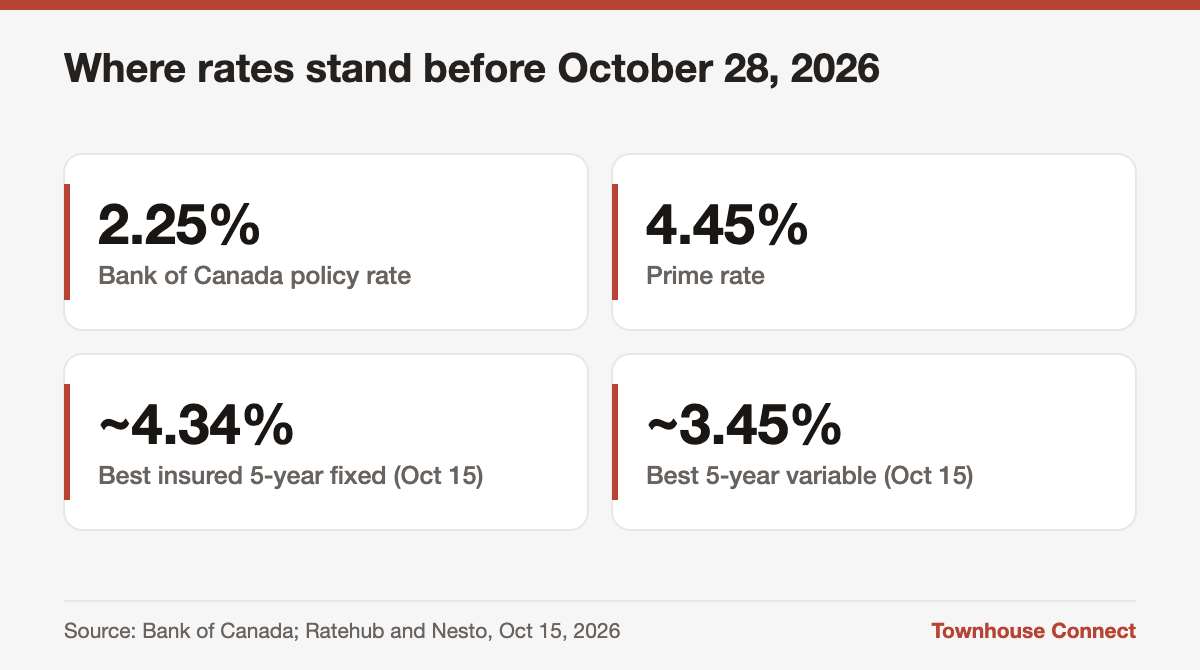
Five-year fixed mortgage rates follow the five-year Government of Canada bond yield more closely than the Bank’s overnight rate. That yield hit a 52-week high of about 3.73% on September 28, and lenders responded. All six big banks raised fixed rates between September and mid-October. BMO, for example, moved its five-year fixed to 5.14% uninsured and 4.99% high-ratio on October 7.
Discount lenders are still lower. As of October 15, the best advertised five-year fixed rates for insured mortgages were roughly 4.3% to 4.6%, and the best variable rates were about 3.4% to 3.5%, or roughly prime minus 1.0%. Uninsured buyers (20% down or more) were seeing quotes closer to 5.1%.
The takeaway: if you are leaning fixed, the October 28 decision is partly priced in already. If you are leaning variable, the decision affects your payment directly, because variable rates move with prime.
How a rate change hits a townhouse mortgage payment
Here is a worked example on a $700,000 townhouse, which sits between the GTA townhouse benchmark of $668,800 and the City of Toronto benchmark of $714,700 (TRREB MLS HPI, September 2026).
- Down payment: $70,000 (10%)
- Mortgage before insurance: $630,000
- CMHC premium at 3.10% (90% loan-to-value, per CMHC’s premium table): $19,530, added to the loan
- Ontario sales tax on the premium, paid in cash at closing: $1,562.40
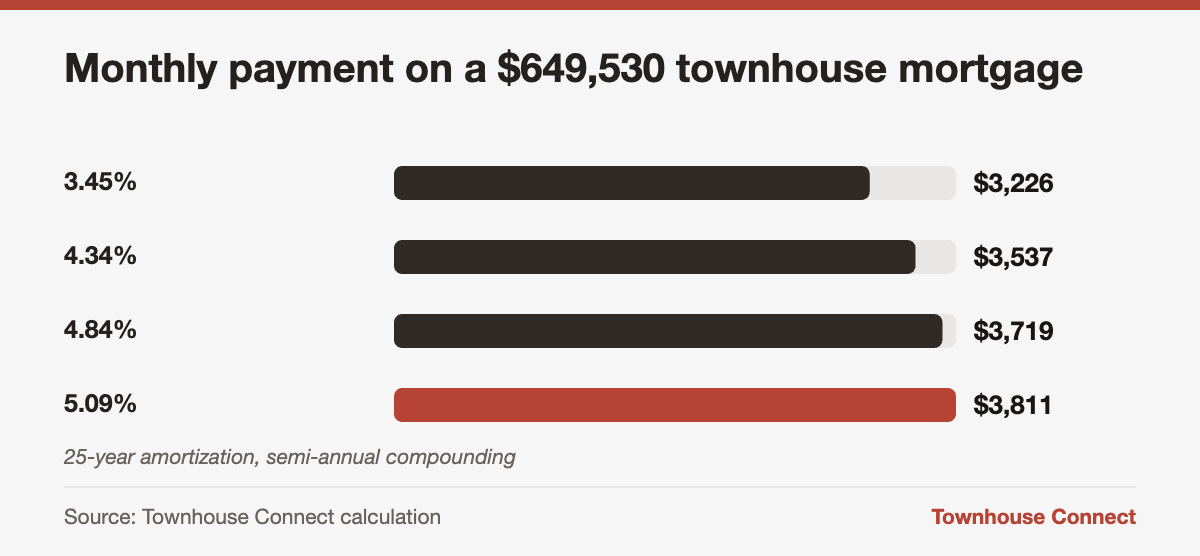
- Total insured mortgage: $649,530, amortized over 25 years
| Mortgage rate | Monthly payment | Change vs 4.34% |
|---|---|---|
| 3.45% (variable, about prime minus 1.0%) | $3,226 | −$312 |
| 4.34% (best insured 5-year fixed) | $3,537 | n/a |
| 4.84% (half point higher) | $3,719 | +$181 |
| 5.09% (typical uninsured quote) | $3,811 | +$274 |
Payments assume semi-annual compounding and are rounded. Over a five-year term, the half-point difference between 4.34% and 4.84% adds about $15,600 in interest on this mortgage. That is real money, but it is not a reason to panic-buy either. It is a reason to know your number.
How the stress test limits how much townhouse you can buy
You do not qualify at the rate you get. Insured and uninsured buyers both qualify at the greater of their contract rate plus 2 points, or 5.25%, under OSFI’s minimum qualifying rate and the matching rule for insured mortgages. At a 4.34% contract rate, that means qualifying at 6.34%.
On the $649,530 mortgage above, the qualifying payment is about $4,288 a month. CMHC caps the gross debt service ratio at 39% of income. If you add an assumed $350 a month for property tax and $100 for heat, a household needs roughly $146,000 of gross income to pass on housing costs alone, before car loans or credit cards are counted against the 44% total debt limit.
If fixed rates rise another half point before you lock in, the qualifying rate becomes 6.84% and the required income climbs to about $152,000. That is how a rate move quietly shrinks your price range, even if the monthly payment you would actually make feels manageable. Condo townhouse buyers should also remember that lenders count half of the monthly condo fee in the same ratio.
Tip: Ask your lender to run your pre-approval twice: once at today’s rate and once at a rate half a point higher. If the higher number still covers the townhouses you are touring, you can shop calmly through October 28. If it does not, narrow your search to stacked or condo townhouses with lower prices, or to the 905 cities where benchmarks are lower.
Fixed or variable for a townhouse purchase this fall?
There is no universally right answer, but the trade-off is clearer than usual this fall.
The case for fixed
You know your payment for five years. If the Bank does hike, you are protected. The cost is a rate roughly 0.9 points above the best variable rates today, which on the example above is about $310 a month.
The case for variable
You start with the lower payment, and most variable mortgages let you convert to a fixed term later. The risk is that a hike on October 28 or December 9 raises your rate immediately. Variable also qualifies at contract plus 2 points, so on a 3.45% rate the qualifying rate is 5.45%, which helps buyers who are close to the limit.
If a $200 to $300 monthly jump would strain your household, fixed is the safer fit. Use our townhouse mortgage calculators to test both against your own budget.
Renewing a townhouse mortgage in late 2026
Owners renewing this fall have more options than they did a few years ago. Since November 21, 2024, a straight switch to another federally regulated lender at renewal is exempt from the stress test, provided the loan amount and amortization do not increase. Insured borrowers can also switch without a new stress test. That gives you leverage: you can take a competitor’s offer seriously instead of signing your current lender’s renewal letter by default.
On a $500,000 balance with 20 years left, the gap between a 4.34% rate and a 5.09% rate is about $200 a month. Start shopping about four months before your maturity date, since many lenders will hold a renewal or switch rate for roughly that long.
Your pre-October 28 checklist
- Get a written pre-approval with a rate hold (holds commonly last 90 to 120 days, depending on the lender).
- Ask the lender to show your maximum price at today’s rate and at half a point higher.
- Price your target townhouse type. Recent September benchmarks are in our Toronto townhouse market report.
- For condo townhouses, add half the monthly fee to your qualifying math, and order the status certificate early.
- Keep your cash-to-close separate: land transfer tax, legal fees and the PST on any CMHC premium cannot be added to the mortgage.
- Read our list of five costly buyer mistakes before you write an offer in a hurry.
A softer market also means you rarely need to rush. GTA sales were down 9% year over year in September, active listings sat at about 4.6 months of inventory, and homes sold at an average of 98% of list price. Buyers have time to do their homework.
Frequently asked questions
Will mortgage rates go up after October 28, 2026?
Nobody can say for certain. The Bank held at 2.25% all year and flagged rising inflation risks, so a hold or a hike is more likely than a cut. Fixed rates have already risen with bond yields, so a hold might not lower them. Variable rates would rise immediately if the Bank hikes, because they follow prime.
Should I wait until after the rate decision to buy a townhouse?
Waiting only helps if rates fall, and the Bank has not signalled cuts. A better approach is to lock in a pre-approval rate hold now, keep shopping, and buy when the right townhouse appears. If rates drop before closing, many lenders will give you the lower rate. If they rise, your hold protects you.
How much does a 0.25% rate increase cost on a townhouse mortgage?
On a $600,000 mortgage amortized over 25 years, moving from 4.34% to 4.59% adds about $83 a month. On the $649,530 example in this article, a half-point increase adds about $181 a month. The bigger impact is often on qualifying, because the stress test rate rises by the same amount and lowers your maximum purchase price.
Does the Bank of Canada rate affect my fixed mortgage?
Not directly. Fixed rates track Government of Canada bond yields, which reflect where markets expect rates and inflation to go. A surprise decision can move bond yields, so it can indirectly change fixed rates offered for new mortgages. An existing fixed mortgage does not change until your term ends and you renew.
Ready to see what your budget buys? Browse townhouses for sale across the GTA, or contact our team to compare freehold and condo townhouses at your price point before October 28.
This article is general information as of October 2026, not legal, tax, mortgage or financial advice. Rules and numbers change, so confirm the details for your situation with a licensed professional.